
The Internet of Things (IoT) has been the hottest technology buzzword in recent years, all of which involve collecting, sharing, and analyzing data and creating value from it. However, without accurate data, the Internet of Things will become a useless technological pile. Therefore, the importance of IoT device management and IoT sensors and actuators enables them to perceive the world and take action.
The Internet of Things consists of several technical layers (the technology behind the Internet of Things) that enable ordinary things to share the data they collect on the Internet, ultimately providing intelligence, autonomous action, and value that largely depend on the quality of the data itself. Therefore, sensors and actuators are an indispensable part of the IoT technology stack and a key factor in the success or failure of every IoT system development.
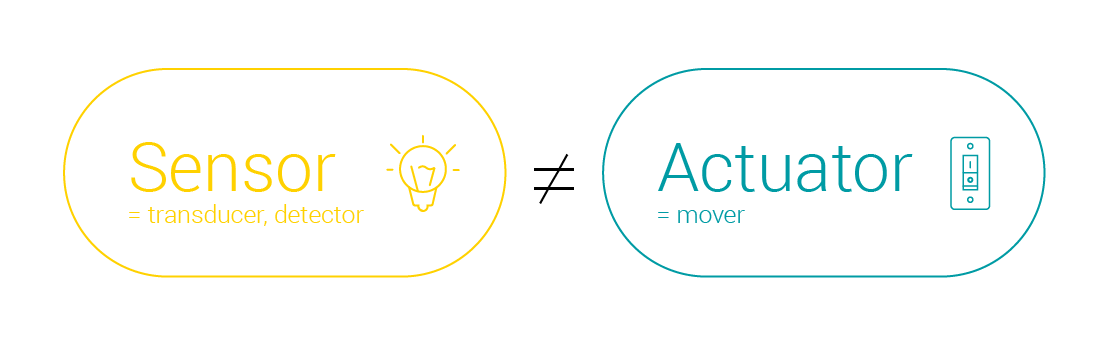
Obviously, sensors and actuators are important for the Internet of Things, but what exactly are they? A sensor, also known as a transducer, is a device whose task is to detect events or changes in the surrounding environment and convert these physical phenomena (such as temperature, light, air humidity, motion, presence of chemicals, etc.) into electrical pulses. Then it can be explained meaningfully. On the other hand, actuators can be seen as tools that act opposite to sensors. By interpreting the electrical pulses emitted from the control system and converting them into mechanical motion, it actually activates them or emits sound or light through various simple actions, including but not limited to opening and closing valves, changing the position or angle of other devices. Simply put, the actuator is called a "mover".
Ordinary electrical sensors and actuators have existed for decades and are ubiquitous in modern industrial applications, but the emergence of the Internet of Things has opened up new possibilities for the application of IoT sensors and actuators, not only in the industrial field, but also in the industrial field. In the fields of commercial and household use. As essential enablers of the Internet of Things, sensors and actuators can help monitor, control, and simplify operations in almost all fields, from smart cars to rainforest conservation. The Internet of Things has completely changed the way they are applied and expanded their scope of use, enabling sensors to be used in powerful cloud based analysis software to develop intelligent solutions for machines, people, and environments.
Considering all the above factors, there is no doubt that in order to maintain its rapid development, the Internet of Things requires increasingly efficient (preferably low-cost) sensor solutions. A reliable sensor and actuator system is the foundation for building every successful intelligent deployment, therefore, it is necessary to understand the types of IoT sensor solutions and options that exist within it. Let's explore the most commonly used types of sensors in the Internet of Things.
IoT Sensor Types
Sensors can be standalone devices or devices embedded in ordinary objects or machines to make them intelligent, and can be classified into several categories based on the physical phenomena to be measured. The following list outlines some of the most widely used sensor types in the Internet of Things.
Temperature Sensor

This most basic sensor can be found in every IoT use case, where tracking the thermal condition of air, work environment, machines, or other objects is crucial. Temperature sensors are particularly useful in manufacturing factories, warehouses, weather reporting systems, and agriculture, where soil temperature is monitored to provide balanced and maximized growth.
- Thermistor: A type of resistor whose resistance (resistance) largely depends on temperature. Thermistors are widely used as sensors in electronic devices, such as temperature sensors in electronic thermometers or temperature sensors in systems to prevent excessive current.
- Resistance Temperature Detector: An instrument used to measure temperature based on resistance changes related to temperature changes.
- Thermocouple: A circuit component composed of two different conductors. By utilizing the fact that the electromotive force generated between the connectors of the thermocouple is proportional to the temperature difference, the thermocouple can be used as a temperature sensor and sometimes even as a power source with very low voltage and relatively high current. Although they are most prominent and widely used in weather stations for reporting and forecasting weather, it is surprising that humidity and humidity sensors are also widely used in agriculture, environmental monitoring, food supply chain, HVAC, and health monitoring.
humidity sensor

Although they are most prominently and widely used in weather stations for reporting and forecasting weather, it is surprising that humidity and humidity sensors are also widely used in agriculture, environmental monitoring, food supply chain, HVAC, and health monitoring.
- Hair tension humidity sensor: Traditional and oldest type of humidity sensor. The design of this device is based on specific properties of human or horse hair, although synthetic fibers or cotton fibers are currently also used. These fibers will change their length when they come into contact with moisture. The pointer that displays the scale reading is connected to the hair (or fiber) and responds to changes in length. The advantages of this type of humidity sensor are undoubtedly its simple structure, low price, and resistance to damage.
- Dryness and Humidity MeterThe construction of such devices is based on two hygrometers (known as "wet dry" and "wet wet"). The mercury container of the humidity thermometer is lined with moisture absorbing material. It utilizes the phenomenon of humid air suppressing evaporation and dry air accelerating evaporation. The higher the humidity, the lower the temperature of the humidity thermometer. The dry thermometer displays the ambient temperature, and the humidity can be calculated based on the temperature difference.
Light intensity sensor

By relying on ambient light intensity, smart TVs, mobile phones, or computer screens can adjust their brightness with the help of light sensors. However, sensors used to detect ambient light are not only common in consumer electronics products, but also in smart city applications. They are increasingly used to adjust streetlights or urban lighting levels to improve economy.
- Photoelectric resistorIt is a photosensitive component whose resistance changes through radiation. It can be easily connected to Arduino as an analog light sensor. Therefore, it is possible to construct lights that automatically light up after dark, for example. Photoresistors can also be used as very simple proximity sensors or even temperature sensors.
- photodiodeA diode that operates based on the photoelectric effect. When photons reach the junction of a photodiode, they are absorbed, which causes electrons to transfer to the conductive band, forming an electron hole pair. Photodiodes are widely used in industrial automation (signal and control systems), telecommunications (optocouplers, optoelectronic links), and many other industries.
Acoustic sensor

Intelligent acoustic sensors enable us to monitor the noise level in a given environment. Acoustic IoT sensor systems, capable of measuring and providing data to help prevent noise pollution, are gradually becoming popular in smart city solutions.
- Hydrophone: A microphone used to pick up sound propagating in water or other liquids. Hydrophones are the fundamental structural elements of passive sonar, such as those used for detecting fish in various aquatic environments.
- Seismic detector: This is a sensor that converts ground vibrations (frequency and amplitude) into voltage. You can say that this is a type of seismometer that has been used on the moon during the "active seismic experiment" of Apollo 16. In order to prevent natural disasters, the data collected by the water level monitoring sensor can be used for analysis and prediction in the flood warning system. In addition to environmental protection, this sensor can also be used in various industrial applications to control and optimize manufacturing processes.
water level sensor

To prevent natural disasters, the data collected by water level monitoring sensors can be used for analysis and prediction in flood warning systems. In addition to environmental protection, this sensor can also be used in various industrial applications to control and optimize manufacturing processes.
- Hydrostatic pressure sensor: used to measure the level of liquid filling. These sensors operate based on liquid level measurement using the so-called static water paradox - the static water pressure measured at the tank measurement point is only proportional to the height of the liquid filling, and is independent of the shape and volume of the tank.
- Optical sensor: A sensor used to detect the water level hidden by the refraction of light in a prism after contact with a liquid. Optical sensors have certain advantages over typical water level sensors because they are limited by mechanical and moving parts that may break or wear out easily.
Displacement Sensor

By emitting electromagnetic radiation beams, this type of sensor can sense the presence of its target object and determine the distance separating the two. With its high reliability and long lifespan, it's no wonder they quickly incorporated it into many IoT fields, such as smart cars, robotics, manufacturing, machinery, aviation, and even smart parking solutions.
- Doppler radar: A radar that uses the Doppler effect, which is the difference between the frequency of the waves emitted by its source and the frequency of the waves recorded by the observer moving relative to the source. Radar is not only used to detect objects and determine their position, but also to understand their direction and speed.
- Occupancy Sensor: A type of sensor that uses infrared light or high-frequency signals to detect movement in offices and sanitation facilities, corridors, passages, warehouses, etc.
Motion Sensor

Intelligent Building System may be the cheapest IoT application that motion sensors can imagine. Although this obvious fact is generally correct, the use of motion sensors has also extended to many other fields such as energy management solutions, smart cameras, automation devices, etc., in addition to helping monitor private or public places for intrusion or theft.
- Active Ultrasonic Motion Sensor: Sending and Receiving Ultrasonic Passive Waves
- Passive Infrared Motion Sensor: Detecting Changes in Infrared Radiation
- Active Radar SensorTransmitting and receiving electromagnetic waves
- There are also some sensor versions that combine all the principles related to motion mentioned above. **Passive infrared sensor (PIR) * * is an example of an electronic sensor used for motion detection, typically in alarm systems, automatic lighting, and ventilation systems.
Attitude Sensor

The task of this sensor is to detect rotation and measure angular velocity, making it highly suitable for navigation systems, robotics, consumer electronics, and manufacturing processes involving rotation. For more everyday IoT applications, gyroscope sensors are increasingly installed in IoT devices used by athletes to accurately measure body movements, analyze and improve their athletic performance.
- Accelerometer: This sensor does not maintain a constant direction, but indicates the angular velocity of the object it is located on. This group includes mechanical gyroscopes with limited rotational degrees of freedom (usually on one axis of the Cartesian coordinate system), optical gyroscopes (laser and fiber optic), and finally gyroscopes that use the Coriolis effect to influence the gyroscope.
- Heading Indicator: A directional gyroscope or heading indicator allows you to observe the rotation of the body to which it is attached. Gyroscopes are typically made as fast rotating rigid objects (usually disks) suspended in a suitable structure, allowing them to freely rotate relative to a reference system (such as the object to which they are attached).
Chemical Sensor

A sensor capable of detecting compounds (solids, liquids, and gases) is an essential element in industrial safety systems, environmental protection solutions, and scientific research. In addition, they have established themselves in IoT supported air quality monitoring, which can help cities and states resist the harmful effects of air and water pollution.
- Electrochemical Respiratory Analyzer: A simple sensor used to determine the alcohol content in the blood. Electrochemical sensors have the ability to resist side effects such as menthol, cigarette smoke, or citric acid, and can indicate the alcohol concentration in exhaled air with an accuracy of 0.000 ‰.
- Electronic Nose: A chemical detector or set of detectors that detect different types of particles or their distinct characteristics (such as the presence of specific chemical bonds, acidity, alkalinity, ability to stabilize adjacent dipoles, etc.) contained in the environment. The information obtained through the use of such detectors can reveal the chemical composition of the environment.
Vision Sensor

By converting optical data into electrical pulses, image sensors enable connected objects to view their surrounding environment and operate on it using intelligence obtained from the provided data analysis. Whenever smart devices need to "see" their surrounding environment, image sensors are used, including smart vehicles, security systems, military equipment such as radar and sonar, medical imaging devices, and of course digital cameras.
- Active pixel sensor: an arrangement of photosensitive elements made using CMOS technology. CMOS sensors can be used in many devices, such as network cameras, compact digital cameras, DSLR (Digital Single Mirror Reflector) cameras, control components in production automation, digital X-ray cameras, etc.
- Charge Coupled Device: A system composed of many photosensitive elements that performs registration and then reads an electrical signal proportional to the amount of light falling on it. The color filters used in CCD sensors often appear in digital cameras, allowing them to record the intensity of a specific spectral width at a given point in the matrix.
IoT actuator type
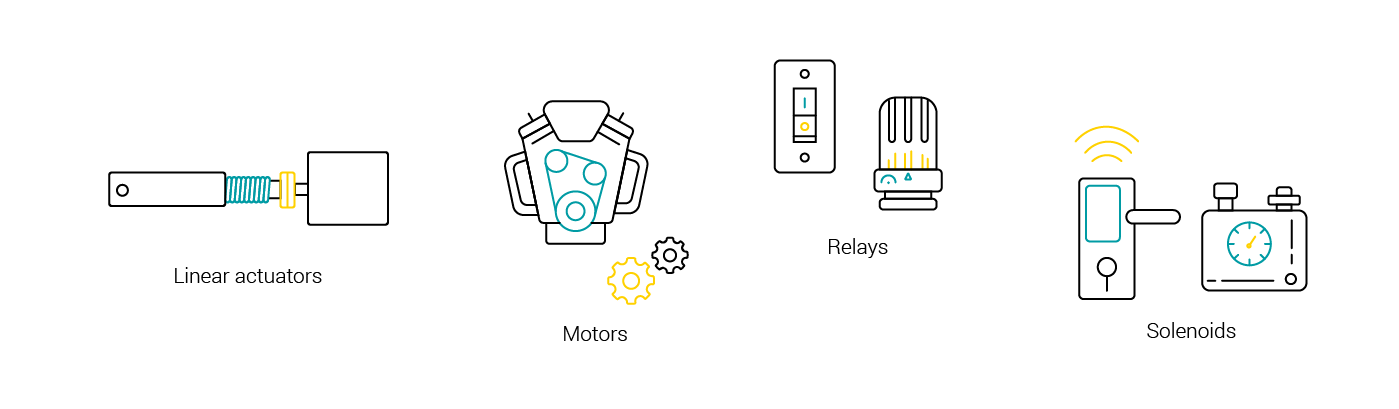
As the name suggests, actuators can function in their direct environment to achieve correct operation of the machine or device they are embedded in. Although they are small, they are rarely seen during operation, but their effectiveness can be felt in vehicles, industrial machines, or any other electronic devices involving automation technology. According to their construction mode and their role in specific IoT environments, they can be divided into four main categories:
- linear actuators- used to move objects or components in a straight line.
- Motors- They enable precise rotational motion of equipment components or entire objects.
- Relays- This category includes electromagnetic based actuators used to operate lights, heaters, and even power switches in smart cars.
- Electromagnetic valve- As part of the locking or triggering mechanism, they are most widely used in household appliances and also serve as controllers for IoT based gas and water leak monitoring systems.
IoT sensors are seemingly insignificant small devices that can feed data into IoT systems, which are the true foundation for building machine intelligence. On the other hand, actuators represent the driving force behind every intelligent enterprise (literally!). In both cases, the Internet of Things is not only interested in how they feel and operate, but also in things that enable us to do things faster and better.


Leave a Reply