
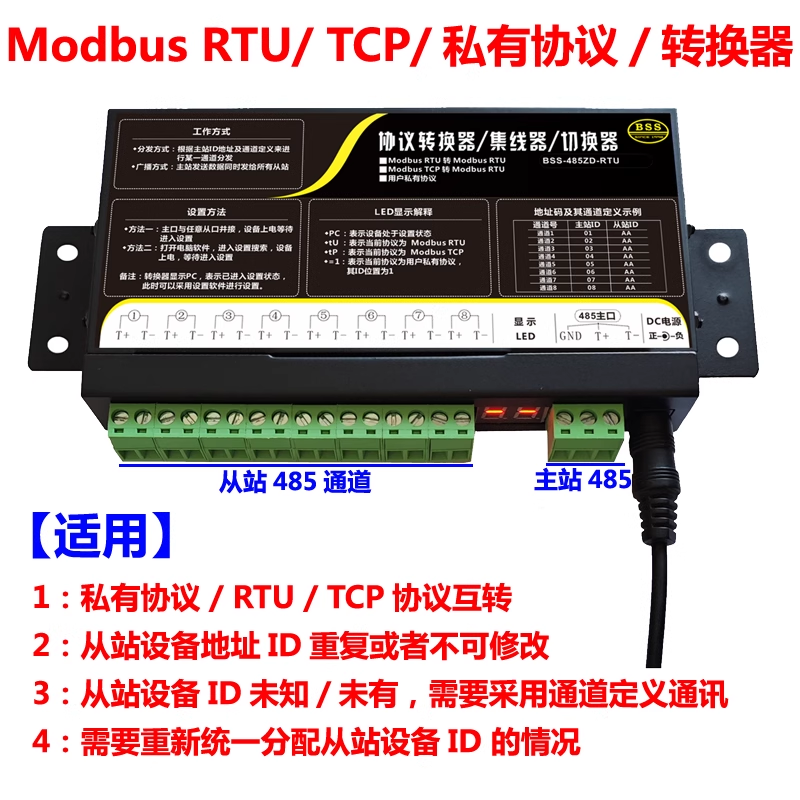
1、 Equipment Overview
This device is an intelligent protocol conversion gateway. Its core mission is to serve as a bridge between the master station and multiple slave stations“Intelligent agent”The core function is not only to complete the conversion of different protocols or interfaces (such as485, TCP/UDP), but also toRe map and unify the management of the addresses of slave devices. Main characteristics:
- •Protocol conversion: supportModbus RTU, Modbus TCPThe mutual conversion between private protocols.
- •Address management: Resolve from the stationIDDuplicate, unknown or non modifiable issues, and support for re allocationID.
- •Working mode: SupportDistribution mode(Accurate communication by address and channel) andBroadcast mode(Simultaneously sending data to all slave stations).
- •Flexible interface: CompatibleRS485Ethernet and virtual serial ports.TCP/UDP2、 Core functions and actual problems solved
The device mainly solves the following three common problems, as shown in the function introduction diagram (Figure 3):
[Function 1] Protocol conversion and
Register remappingID/This is the basic function of the device. It can serve as different
Translation gateway between protocol variants, and even between private protocols. At the same time, it supports reallocating the addresses and register addresses of slave devices, making it easier for the master station to access them using a unified protocol.Modbus[Function 2]
Resolve from the stationRepetitive and unchangeable challengesIDThis is the most prominent value point of the equipment. As shown in the schematic diagram of Figure 2, when the slave devices on multiple buses leave the factory
All areIDWhen they cannot be modified, the main station cannot distinguish them.“01”Solution
- •This device defines each physical port as oneChannel“(such as channels 1 to 8). The master station no longer directly sends to the target slave station”Instead of sendingIDChannel number“And”The original station within the channel“WorkflowID”.
- •: Main station queryOn channel 1“From the stationID=01The device receives instructions and converts them into queries that are sent to the physical bus of channel 1” -> From the stationID=01After the slave station responds, the device returns the response data to the master station. In this way, even if all the subordinate stations -> All are The main station can also accurately locate through channel numbers.ID[Function 3] Handling slave stations01Unknown or chaotic situations
When standingIDWhen unknown or chaotic, it is difficult for the main station to poll.SolutionID: Utilize
- •Broadcast address () combined with channel definition. The master station sends a broadcast command to a certain channel, and all slave stations on that channel will execute the command (such as data collection), but only the target slave station will respond. After the device captures the response, the master station can know the actual status of the slave stationModbusBroadcast address(00)And combined with channel definition. The master station sends a broadcast command to a certain channel, and all slave stations on that channel will execute the command (such as data collection), but only the target slave station will respond. After the device captures the response, the master station can know the actual status of the slave stationIDAnd it can be further mapped using Function 2 for fixed mapping. The device also supports reallocating an orderly new set for these chaotic slave stationsID(such as01to32), greatly simplifying the programming of the main station.
3、 Detailed explanation of working principle
Equipment passes through“Channel mapping”There are two main ways for the mechanism to achieve the above functions:
- 1.Distribution mode (main mode)
- •Maintain a mapping table within the device, which definesThe logical address issued by the main stationAnd withPhysical channel number+actual slave stationIDThe corresponding relationship.
- •Example(Refer to Table 1 in Figure 1): The main station wants to read“Communication number”For01The slave data only needs to be sent to the destination address01The instruction. The converter was found searching in the internal mapping table“Communication number01”corresponding“Channel1”Up“From the stationID 02”. So, it changed the target address in the instruction to02And through channel 1RS485Bus transmission enables precise communication.
- 2.Broadcast modeThe data sent by the master station will be forwarded to all slave devices on all channels simultaneously. This mode is suitable for scenarios where the same command needs to be issued to all devices simultaneously, such as synchronizing time and starting and stopping simultaneously.
4、 Application scenarios
- 1.Equipment reuse and system integration: will only supportModbus RTUConnect old devices to new ones based on Ethernet (Modbus TCP)SCADASystem.
- 2.Multi vendor equipment integrationWhen equipment from different suppliers is used repeatedlyModbusWhen addressing, system integration can be achieved without changing devices.
- 3.Batch management of intelligent instrumentsIn large buildings, smart meters or water meters installed in batches may have the same address, and through this device connected by channels, individual reading of each instrument can be achieved.
5、 Summary
BSS-485ZD-RTUThe protocol converter goes beyond simple protocol conversion functions and is a powerful communication management gateway. It passed“Channelization”The management philosophy decouples physical connections from logical addresses, solving the problem in an elegant and low-cost mannerModbusThe most troublesome issues in system integration are address conflicts and management confusion. For system integrators and engineers, this device is a powerful tool for quickly achieving device networking and building stable and reliable industrial communication networks.


Leave a Reply