

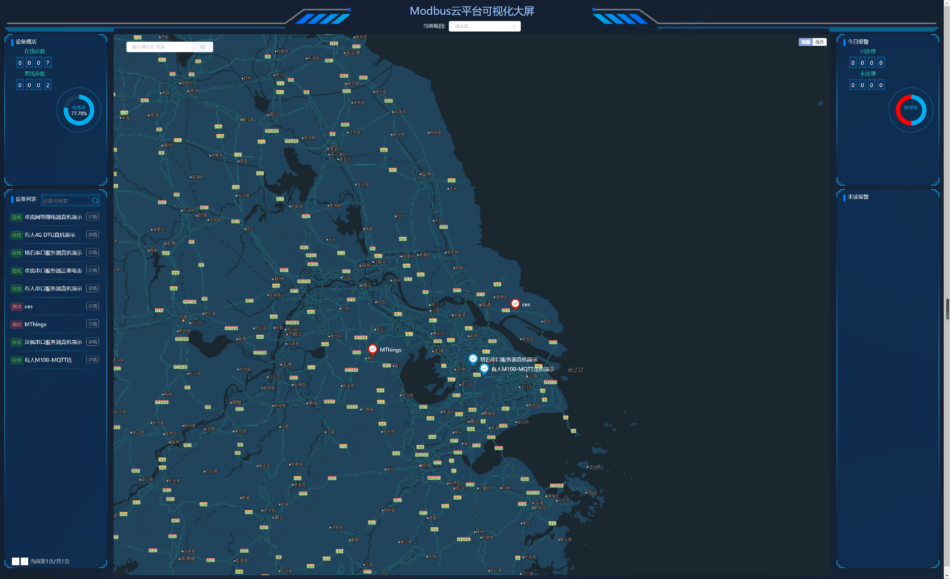
The IoT (Internet of Things) platform essentially belongs to IoT PaaS, which means that IoT network devices have access to and applications have an open tool platform for secondary development. Those focusing on individual deployment are also commonly referred to as IoT towers, IoT network operating system platforms, IoT network middleware platforms, etc. So,which PLC IoT cloud platform is better??
which PLC IoT cloud platform is better?? Tooling can create, add, and manage device systems connected through the IoT platform, and provide various other configurable functions, without requiring platform customization and development, to solve hot issues related to IoT network device management such as warning thresholds, event correlation, driver configuration, etc.
Openness provides external SDKs or APIs in terms of device access and data applications, extends device drivers or business applications through secondary development, provides extended support for accessing device types, and provides business support for IoT data applications.
In recent years, the concept of IoT operating system (IoT OS) has often been proposed as a new concept, which is more specific and less extensive than a platform, touching upon the essence of the IoT network, that is, the operating system.
Windows provides some hardware integration for cooling, device driver development support, third-party application development support, file storage, application process planning, and network communication processing for built-in or peripheral devices of PCs. Android is similar, but adds specific features such as gyroscopes, NFC, fingerprints, and mobile network modules to mobile hardware.
Like IoT OS, it is a device distributed through wired or wireless internet in intelligent project scenarios (such as fire protection, access control, parking, lighting, ventilation, elevators, temperature, water level gauges, etc.). It supports device driver development, interface protocol conversion, third-party application development, and provides API data interfaces. It provides data storage, distribution, command scheduling, communication processing, etc. in the middle.
which PLC IoT cloud platform is better?? IoT network requirements are highly fragmented. Scenarios can be divided into smart home (consumer IoT network), smart manufacturing (industrial internet), and smart city. For smart cities, system integration must be mentioned. Information system integration projects have high customer unit prices and large B-to-G attributes (such as smart buildings, smart campuses, smart communities, etc.).
Accessing subsystems differs significantly from interacting with smart hardware or industrial devices. In the process, subsystems are typically inventory devices that provide ready-made interfaces composed of SDKs/APIs and await integration led by third-party platforms. The device industry protocols, data packet formats, and the ways manufacturers actively engage with platforms vary greatly.
Technically, most platform architectures are designed for incremental smart hardware, such as MQTT asynchronous communication options, without considering multi-language development. This makes it quite troublesome when interfacing with inventory subsystem devices, which can affect project delivery and acceptance efficiency.
Which PLC IoT cloud platform is the best?On an IoT platform, "access" is just one aspect and not crucial. However, the standardization and versatility of the platform (such as sensors, smart hardware, subsystems, algorithms, databases, platform services, streaming media, etc.) are primarily manifested in its access capabilities.
Which PLC IoT cloud platform is the best?IoT platforms will be launched in the future. With the digital upgrade of industries, IoT platforms are playing an increasingly significant role in system integration scenarios such as buildings, campuses, and communities.


Leave a Reply