
The fourth industrial revolution brings about advancements in technologies such as the Industrial Internet of Things (IoT), Artificial Intelligence (AI), Augmented/Virtual Reality (AR/VR), digital twins, digital threads, and more. However, among these technologies, there is no equivalent to IoT. For many, smart manufacturing and the Industrial Internet of Things (IIoT) platform are almost synonymous. When discussing smart manufacturing, people quickly turn to talk about IoT. In the field of smart manufacturing, IoT is ubiquitous and can be seen in most smart manufacturing solutions. The following briefly introduces the advantages of the IIoT platform, specifically in terms ofIoTand its benefits.
1. Smart Advantages
One of the greatest advantages of the IIoT platform is its ability to lay the foundation for a wide range of smart manufacturing solutions. Machine Learning (ML), AI, big data, analytics, Manufacturing Execution Systems (MES), Enterprise Resource Planning (ERP), digital twins, digital threads, and many other applicationsOne of the greatest advantages is its ability to lay the foundation for a wide range of intelligent manufacturing solutions. Machine learning (ML), artificial intelligence, big data, analytics, manufacturing execution systems (MES), enterprise resource planning (ERP), digital twins, digital threads, and many other applications
are all part of it. Another significant advantage is its ability to leverage existing technologies for expansion. Machine-to-Machine communication, sensors and sensor data, automation, and control systems are all part of it and have been around for a long time, so it is not considered something new. It also connects with information systems such as MES and ERP for transactions, data provision, analysis advancement, and real-time visibility support.
Finally, the real advantage lies in all the aforementioned aspects. It provides a communication platform supporting multiple IoT applications. It fully utilizes existing technologies as complementary solutions, rather than competing solutions. It is associated with large information systems that most companies already possess.
2. Basic Capability Advantages
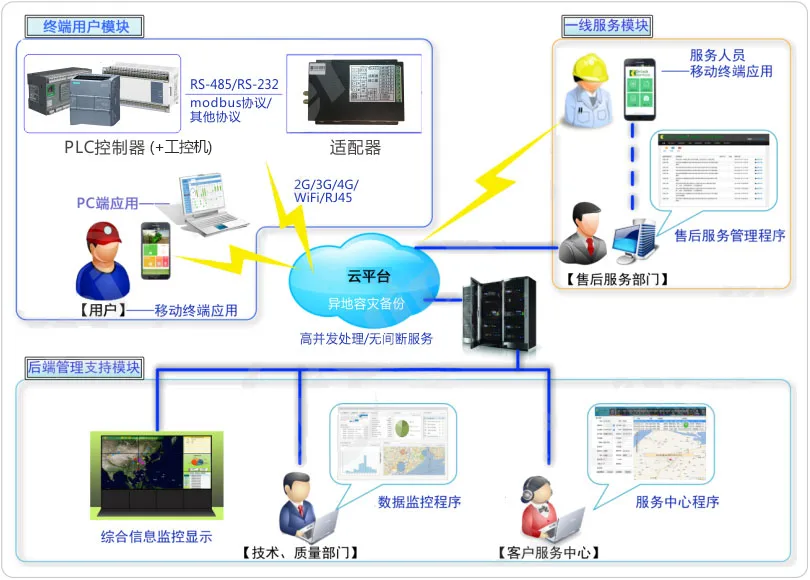
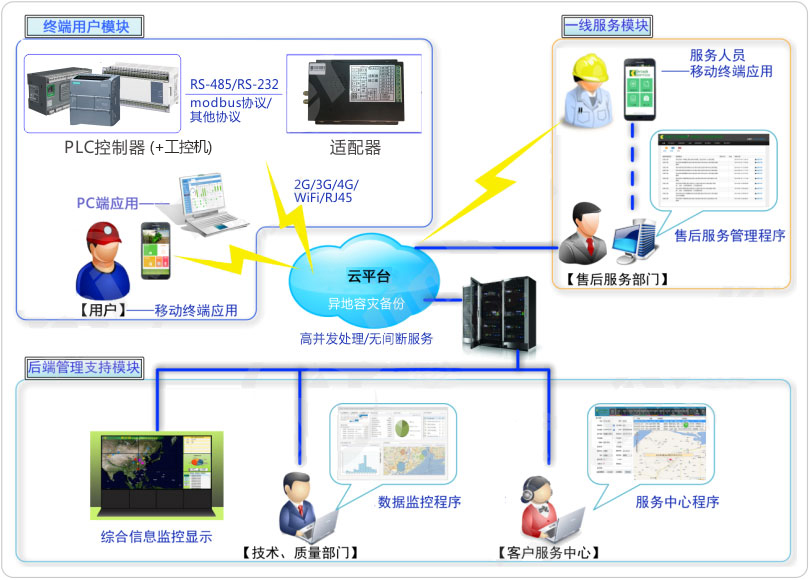
At the bottom layer, the IIoT platform serves as middleware providing a communication backbone between devices, machines, controllers, databases, information systems, and personnel. Basic functions are used for monitoring, managing, and maintaining connected devices and systems.
It also supports the sequential real-time transmission of systems and applications requiring large amounts of data (such as sensor data). In other words, it serves as the basic interface or middleware information (EMI) between almost all edge objects (such as sensors, devices, machines, and controllers) and all user-oriented application sequences (such as HMI, MES, ERP, enterprise manufacturing). Many platforms and solutions go beyond the basics of interfaces and middleware, providing highly complex functionalities for data collection, data aggregation, data visualization, and data analysis.
someOne of the latest features provided by the Industrial Internet of Things (IIoT) platformis the ability to publish various sensor, device, machine, and controller data, along with their context, to almost any external system for analysis. These functions are typically independent of application sequences and systems, and often support asynchronous message-based event processing and publishing. All of this constitutes an excellent solution, enabling you to obtain the required data without the need to constantly poll for changes.
3. Smart Object Advantages
Another new feature is the intelligent AI object. Intelligent AI objects encapsulate the main aspects of manufacturing and mechanical operations (recipes, configurations, tools, states, etc.) and are built into an object-based AI data model. Afterwards, this model becomes universal, and these intelligent AI objects can be used or reused wherever data is needed.


Leave a Reply