
USB Host + customized firmware, directly connected to an HID barcode scanner, with scanned content being passed into Lua via the on_key(key) callback. Applicable to industrial warehousing and production line traceability. HMI&M&DX series + USB interface + customized firmware.
1. API: on_key(key)
where key is a 16-bit unsigned integer: the lower 8 bits represent the USB HID Usage ID (scan code), and the upper 8 bits represent the Shift status (non-zero indicates Shift is pressed, distinguishing between uppercase and lowercase).If the lower 8 bits == 0x28 (Enter), it indicates the end of the barcode, at which point the string is submitted and the buffer is cleared.
2. Lua: Convert HID scan codes to ASCII
by mapping the Usage ID to characters (including uppercase with Shift) using a lookup table. When encountering the 0x28 end character, write to LW2000:
_barCode = ""
usbScanGun = {
  [0x04] = {"a","A"}, [0x05] = {"b","B"}, ... [0x1D] = {"z","Z"},
  [0x1E] = {"1","!"}, [0x1F] = {"2","@"}, ... [0x27] = {"0",")"},
  [0x2C] = {" "," "}, [0x28] = {"n","n"}  -- Enter
}
function on_key(key)
  local usage = key & 0xFF
  local shift = (key >> 8) & 0xFF
  if usage == 0x28 then        -- 结束符
    set_string(VT_LW, 0x2000, _barCode)
    _barCode = ""
    return
  end
  local ch = usbScanGun[usage]
  if ch then
    _barCode = _barCode .. (shift ~= 0 and ch[2] or ch[1])
  end
end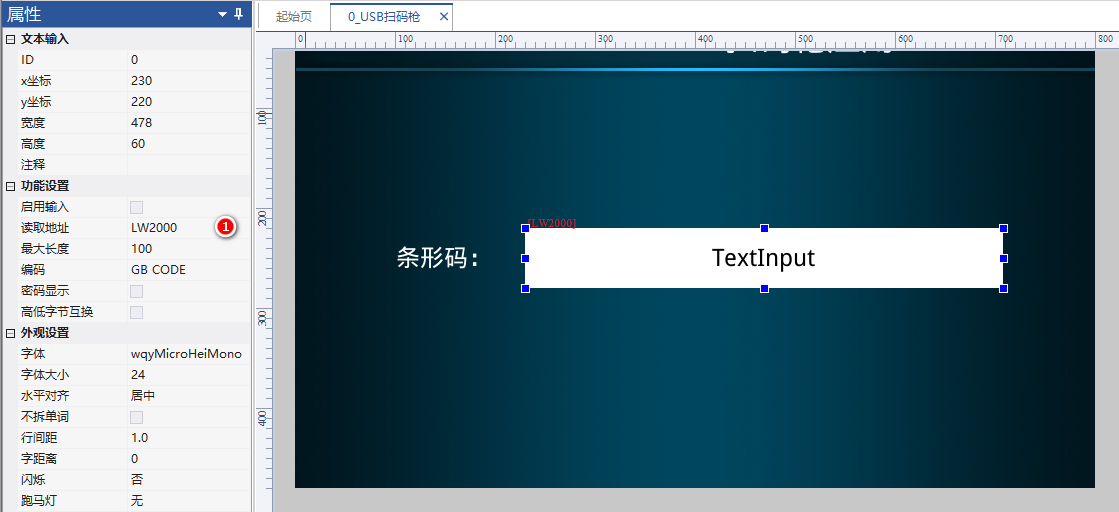
Compiled from the VisualHMI development documentation of Guangzhou Dacai Technology (hmi-doc.gz-dc.com) and other technical tutorials titled "USB HID Barcode Scanner", copyright reserved by Dacai Technology.


Leave a Reply