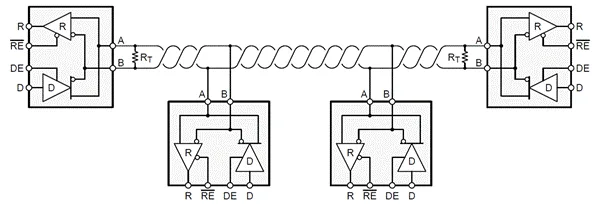
RS-485 bus termination is useful in many applications as it helps improve signal integrity and reduce communication issues. Termination "refers to matching the characteristic impedance of the cable with the termination network, so that the receiver at the end of the bus can observe the maximum signal power. Unterminal or improperly terminated buses will not match well, resulting in reflections at the end of the network and a decrease in overall signal integrity.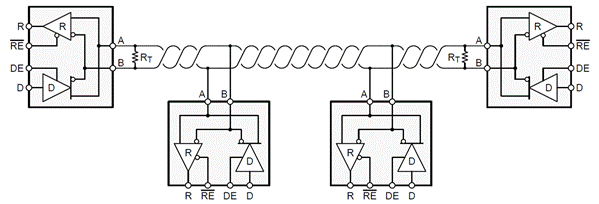 Figure 1: RS-485 bus with parallel termination2. What is fault safety bias and how can it be implemented?Fault safety bias is a way to ensure that the RS-485 receiver is not in an uncertain state due to differential input voltage. The Electronic Industries Alliance (EIA) -485 standard states that when the differential voltage is ≥+200mV, the input threshold of RS-485 is logic high; When the differential voltage is ≤ -200mV, the input threshold of RS-485 is logically low, thus maintaining an uncertain state of 400mV between high and low thresholds.How to calculate the maximum number of nodes on the RS-485 bus?RS-485 is a multi point differential bus, which means that all nodes on the bus share a common transmission medium. As the total number of nodes increases, the load on each drive will also increase accordingly.
How to add a ground wire between nodes at the appropriate time?When designing a remote data link, it is necessary to assume the existence of some ground potential difference. These voltages will add common mode noise Vn to the transmitter output. Even if the total superimposed signal is within the input common mode range of the receiver, relying on the local ground potential difference as a reliable path for the return current is unsafe. When the ground potential difference (GPD) exceeds the common mode range of the receiver (which often occurs in long cables and high current loads), appropriate grounding techniques are required.
Figure 1: RS-485 bus with parallel termination2. What is fault safety bias and how can it be implemented?Fault safety bias is a way to ensure that the RS-485 receiver is not in an uncertain state due to differential input voltage. The Electronic Industries Alliance (EIA) -485 standard states that when the differential voltage is ≥+200mV, the input threshold of RS-485 is logic high; When the differential voltage is ≤ -200mV, the input threshold of RS-485 is logically low, thus maintaining an uncertain state of 400mV between high and low thresholds.How to calculate the maximum number of nodes on the RS-485 bus?RS-485 is a multi point differential bus, which means that all nodes on the bus share a common transmission medium. As the total number of nodes increases, the load on each drive will also increase accordingly.
How to add a ground wire between nodes at the appropriate time?When designing a remote data link, it is necessary to assume the existence of some ground potential difference. These voltages will add common mode noise Vn to the transmitter output. Even if the total superimposed signal is within the input common mode range of the receiver, relying on the local ground potential difference as a reliable path for the return current is unsafe. When the ground potential difference (GPD) exceeds the common mode range of the receiver (which often occurs in long cables and high current loads), appropriate grounding techniques are required.
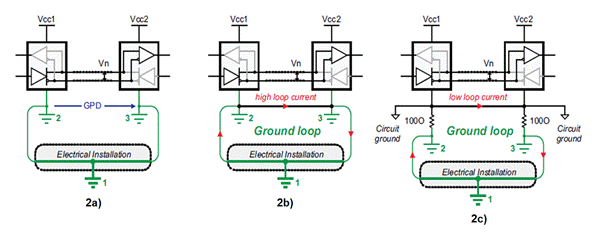 Figure 2: Remote node configuration: independent grounding point (a); Directly connected remote grounding (b);What are the recommended values for the length and speed of RS-485?At the rated data rate, the maximum bus length is limited by transmission line losses and signal jitter. Due to jitter at a baud rate of 10% or higher, data reliability sharply decreases. Therefore, Figure 3 shows the cable length and data rate characteristics of a traditional RS-485 cable under signal jitter of 10%.
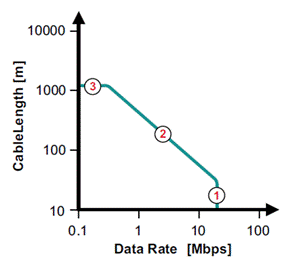 Figure 3: Cable length and data rate recommendations
How to estimate the power consumption of RS-485?To calculate power consumption, power can be divided into several parts. When the device is powered on without an external load, the power consumption will be used for the integrated circuit itself. If a load is added to the output pin, the power driving the load will be extracted from the device. Due to the differential signal of RS-485, the load is usually added between pins A and B.
Figure 3: Cable length and data rate recommendations
How to estimate the power consumption of RS-485?To calculate power consumption, power can be divided into several parts. When the device is powered on without an external load, the power consumption will be used for the integrated circuit itself. If a load is added to the output pin, the power driving the load will be extracted from the device. Due to the differential signal of RS-485, the load is usually added between pins A and B.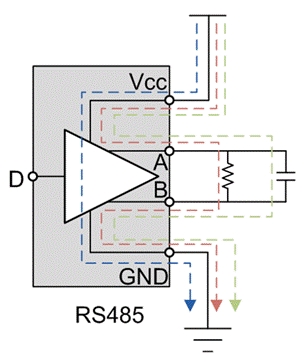 Figure 4: Calculating power consumption sectorsHow to protect the RS-485 interface from electrostatic discharge (ESD)?There are various types of ESD protection, including human body models, International Electrotechnical Commission (IEC) contact discharges, and IEC air gap discharges. If a transceiver has integrated IEC ESD (such as Texas Instruments' THVD1450 or THVD1500), it can protect the RS-485 interface from ESD at the specified transceiver level without the need for external components.8. How to determine if an external TVS diode is needed?Industrial networks must operate reliably in harsh environments. Electrical overstress transients caused by ESD, switching of inductive loads, or lightning strikes can disrupt data transmission and damage bus transceivers unless effective measures are taken to reduce transient effects.How to prevent high voltage short circuits?In many RS-485 applications, there is a risk of accidentally connecting communication lines to power lines. This risk is particularly high in on-site installed systems, such as HVAC systems, lighting control, or other building automation applications. In these cases, it is necessary to ensure that the RS-485 transceiver is not damaged to avoid expensive on-site returns and reinstallation risks.
Detailed explanation of RS-485 transceiver difficulties
freeFree Technical Resource
This content is free to read, suitable for basic learning and search traffic.
modbus Technical Team 约 10 min read
约 10 min read
When is it necessary to terminate on the RS-485 bus and how to do it correctly?


Leave a Reply