
In industrial automation and control systems, communication protocols are one of the key factors ensuring effective communication between devices. Profibus and Modbus are two common industrial communication protocols, each possessing certain advantages and characteristics in different application scenarios. This article will compare these two protocols to help readers understand their differences.
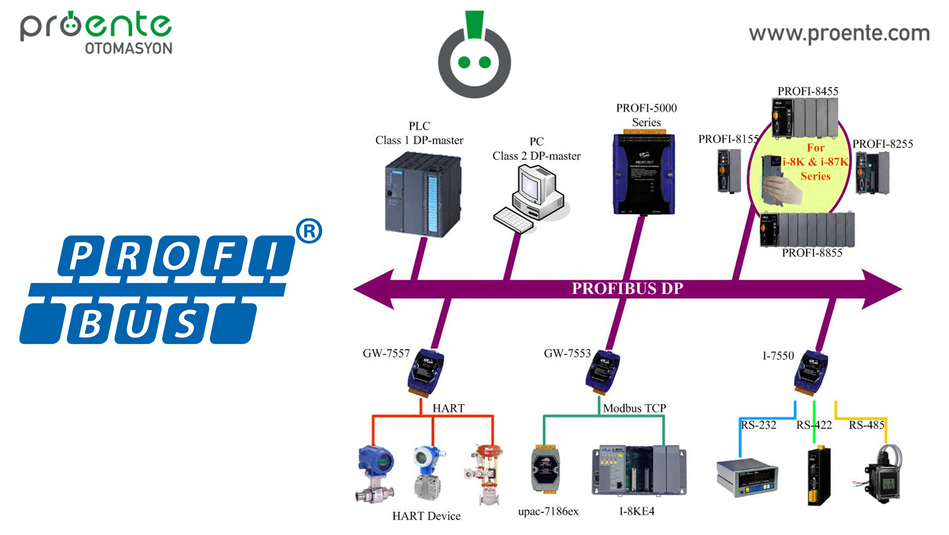
1. History and Development
- Profibus:Profibus is a communication protocol jointly developed by the German Association of Industrial Automation (ZVEI) and the German Electrical and Electronic Manufacturers' Association (ZVEI). It was first introduced in 1990 and, after years of evolution and improvement, has now become one of the most widely used industrial communication standards globally.
- Modbus:The Modbus protocol was originally developed by Modicon (now Schneider Electric) in 1979 and is a relatively older communication protocol. It was initially designed for connecting PLCs (Programmable Logic Controllers) and industrial instruments, but has since been widely used for communication between various industrial devices.

2. Communication Methods
- Profibus:Profibus supports multiple communication media, including RS-485, fiber optics, and wireless. It provides high-speed data transmission, suitable for industrial environments requiring fast real-time communication.
- Modbus:Modbus was originally a serial communication protocol, but has since been extended to support Ethernet communication. It typically transmits data in ASCII or RTU format, suitable for simple data exchange and remote monitoring.
3. Data Structure
- Profibus:Profibus is typically used in more complex systems, supporting multiple data structures, including bit data, word data, and strings. This makes it highly suitable for connecting multiple devices in large industrial automation systems.
- Modbus:Modbus is commonly used in simpler systems, with a relatively simple data structure that mainly includes Coils, Input Coils, Holding Registers, and Input Registers.
4. Performance and Applicability
- Profibus:Due to its high-speed transmission and complex data structure, Profibus is suitable for large industrial control systems, such as manufacturing automation and process control. It excels in real-time performance and reliability.
- Modbus:Modbus is typically used in small to medium-sized applications, such as building automation and temperature control systems. It has lower real-time performance but is sufficient for many simple industrial communication needs.
5. Flexibility and Cost
- Profibus:Profibus typically requires more hardware and software resources, thus resulting in higher costs. However, it provides more functionality and performance.
- Modbus:Modbus is a relatively simple and economical communication protocol, suitable for projects with limited budgets. Due to its widespread application and support, Modbus devices are usually easier to obtain.
6. Ecosystem and Support
- Profibus:Due to its long existence and widespread application, Profibus boasts a rich ecosystem and vendor support. Users can easily find a variety of compatible devices and solutions.
- Modbus:Modbus also has a wide ecosystem, with many devices and control systems supporting Modbus communication. This makes it a popular choice.
In summary, Profibus and Modbus are two different industrial communication protocols, each with its own advantages and applicability. The choice of protocol depends on the specific application requirements, including real-time performance, complexity, cost, and available devices. Regardless of which protocol is chosen, careful consideration needs to be given based on specific circumstances to ensure the smooth operation of industrial automation systems.


Leave a Reply