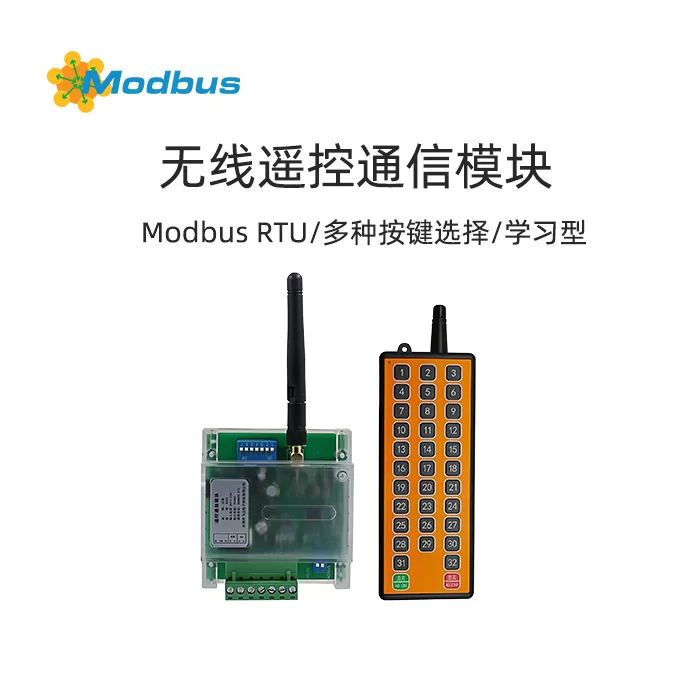
Modbus RTU remote control communication module: remote control wireless signal to MODBUS RTU protocol data
¥145.00 – ¥315.00Price range: ¥145.00 to ¥315.00
In industrial automation and control systems, the traditional PLC direct wiring control method often faces many challenges such as limited port resources, compl
Description
In industrial automation and control systems, the traditional PLC direct wiring control method often faces many challenges such as limited port resources, complex and messy wiring, and limited installation space. How to expand control points in an economical, reliable, and concise manner has become an urgent problem for engineers to solve.K485 remote control communication moduleAs a result, it innovatively combines wireless remote control technology with the standard MODBUS RTU industrial protocol, providing a "plug and play" wireless I/O expansion solution for PLCs, DCS, and other industrial controllers, fundamentally optimizing the structure and implementation efficiency of control systems.1. Product Core Positioning: The wireless tentacle of industrial controllers
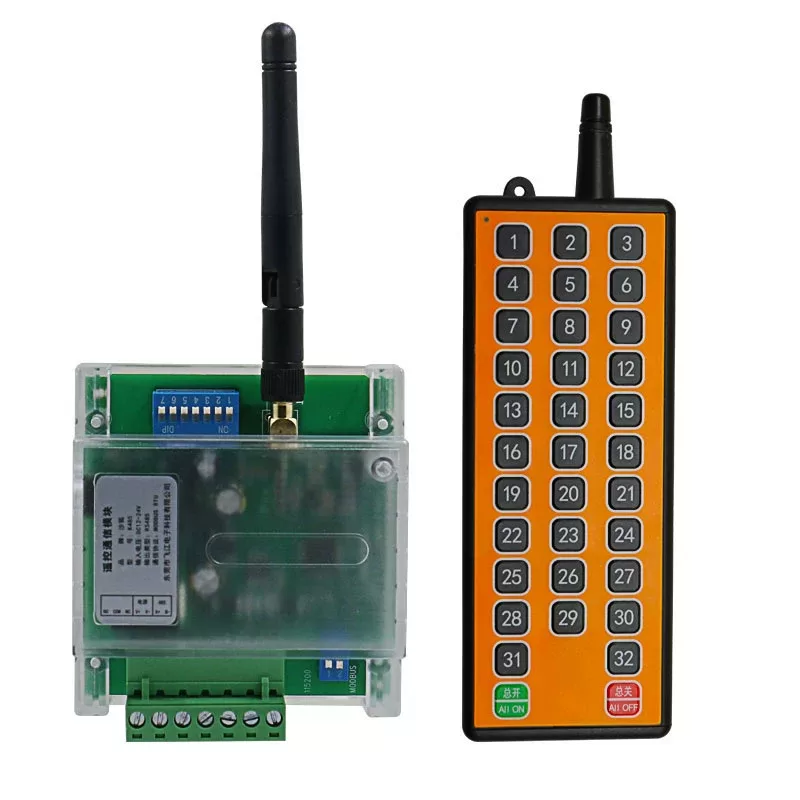
K485 module is a signal conversion and communication hub designed specifically for industrial environments. Its core function is to receive wireless RF signals from the matching remote control, convert them into standard MODBUS RTU protocol data, and transmit them to the upper computer (such as PLC, industrial control computer) through RS485 interface. This allows engineers to achieve wireless remote control of up to 34 or even more control points through a single RS485 interface, without the need to lay physical wiring for each control point, greatly simplifying the system design, installation, and maintenance process.2. Three major industrial control core pain points solved
K485 module directly hits the most common problem in industrial sites:
- Cracking the "port shortage" dilemma
- Problem: PLC has limited built-in digital input points, and adding an expansion module separately is costly.
- Solution: A K485 module only occupies one RS485 communication port, which can receive instructions from up to 34 buttons, equivalent to expanding 34 wireless remote control points, with extremely high cost-effectiveness.
- Ending the chaos of "unsightly and dangerous wiring"
- Problem: A large number of physical buttons and circuits cause messy wiring inside the control cabinet, which is not only unsightly, but also poses a risk of short circuit and accidental contact.
- Solution: By adopting wireless remote control, more than 90% of the control lines have been fundamentally reduced, making the wiring inside the cabinet simple and clear, greatly improving safety and reliability.
- Overcoming the limitation of "large module size"
- ProblemTraditional I/O modules have a large volume and are difficult to install in space constrained distribution cabinets.
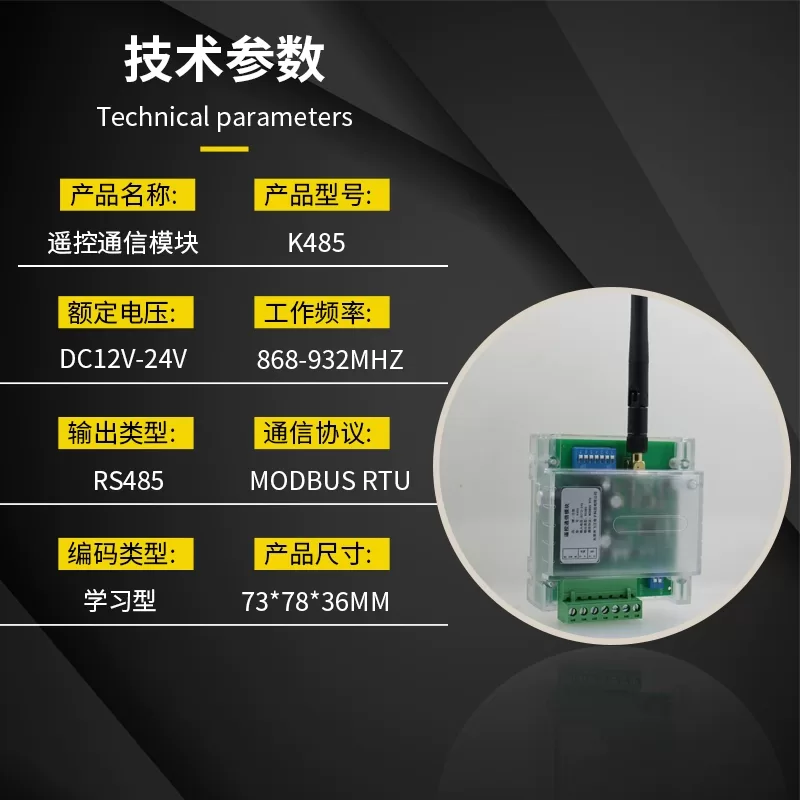
- SolutionThe K485 module has a size of only 73 * 78 * 36MM (length * width * height), with a compact structure and rail mounted installation, greatly saving valuable space inside the distribution cabinet.
3, Core technological advantages: anti-interference, easy-to-use, standardized
1. Super anti-interference and stable communication
- Industrial grade RFThe working frequency is868-932MHZStrong penetration ability, good diffraction performance, suitable for complex industrial environments.
- Robust designBuilt in high-performance antenna, specifically designed forDistribution boxOptimize scenarios with certain electromagnetic interference to ensure the stability and reliability of signal transmission.
2. Learning oriented coding and flexible configuration
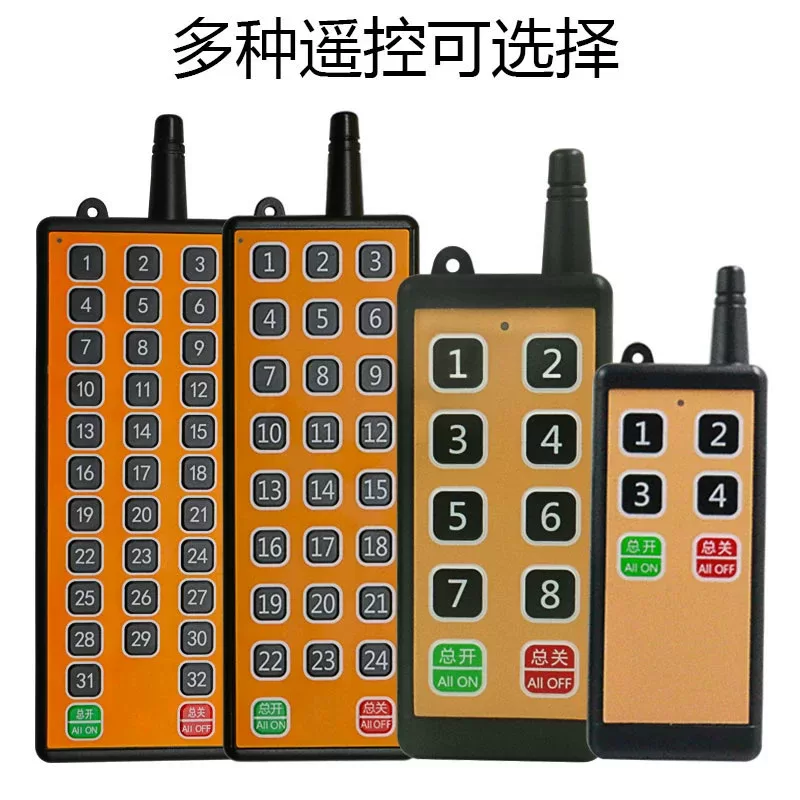
- Learn and use now: AdoptingLearning oriented codingTechnology allows users to easily pair multiple remote controls with different numbers of keys (such as 34 keys, 26 keys, 10 keys, 6 keys) with a receiving module, making the configuration process simple and fast.
- Multiple Remote Control OptionsFour specifications of remote controllers are available to meet different application needs, from simple device start stop to complex multi device group control. All remote controls are equipped with "All ON" and "All OFF" buttons for easy one click operation.
3. Standard MODBUS RTU protocol, seamlessly integrated
- Industrial Common Language: Supports standardMODBUS RTUThe protocol and function code are03H(Read and hold register), can be easily integrated into any automation system that supports this protocol (such as Siemens, Mitsubishi, Delta and other brands of PLC and SCADA, HMI software).
- Plug and Play: No need to develop private drivers, greatly reducing project integration and debugging time.
IV. Detailed Explanation of Communication Protocol and Data Frame Format
As a MODBUS RTU slave device, the K485 module has a clear and concise communication process.When queried by the upper computer (main station), the data frame format returned by the module is as follows:
|
|
|
|
|
|
|
Device Address Fixed to 08H (can be modified by instructions) |
|
|
|
is fixed to 03H, indicating the number of data bytes for read register operations |
|
|
|
, indicating that the subsequent valid data is 4 bytes |
|
, remote control key value |
|
, core data area, 32-bit unsigned integer, indicating the pressed key |
|
|
|
, cyclic redundancy check code used to verify data integrity |
2. Key value parsing principle
- . The module maps the 34 keys of the remote control to a 32-bit bitmap (Bitmask).
- Each key corresponds to one bit in the bitmap. For example, when key 1 is pressed, the key value data is
01 00 00 00(hexadecimal); Press keys 1 and 2 simultaneously, and the key value data is03 00 00 00(hexadecimal, i.e. 1+2=3). By parsing the 32-bit number, the upper computer can accurately determine which key or keys have been pressed.
- The upper computer can accurately determine which button or buttons have been pressed by parsing the 32-bit number.
3. Communication instance
-
- Host query:
08 03 00 01 00 02 95 52
- Module return:
08 03 04 01 00 00 00 62 CF(key=0x00000001)
-
- Module return:
08 03 04 00 00 00 00 63 33(key=0x0000000)
V. Detailed technical parameters
|
|
|
|
|
Remote control communication module |
|
DC 12V-24V (wide voltage design) |
|
|
|
|
|
|
|
|
|
73mm × 78mm × 36mm (length × width × height) |
| Supporting Remote Control |
34/26/10/6 keys (optional) |
VI. Key Points for Installation and Use (Product Interface Description)
To ensure reliable operation of the module, special attention should be paid to the following points during installation:
- Environmental Requirements: Controller installation position should pay attention toWaterproof and moisture-proof, Avoid installation in condensation or splashing areas.
- Safety First: Before performing any wiring operation, be sure todisconnect the power supplyand pay attention to electrical safety.
- Signal optimization: Distribution boxes, metal boxes, etc. may cause signal shielding. During installation, it is essential to remove the black antenna that comes with the module from the box body to ensure optimal reception.Pull the black antenna attached to the module out of the boxTo ensure the best reception effect.
- Stay away from interference: Installation location should beStay away from strong electromagnetic interference sources such as large transformers and high-voltage linesTo avoid affecting the normal reception and decoding of signals.
7. Typical Application Scenarios
K485 module is widely used in scenarios that require wireless remote control or simplified wiring:
- Intelligent buildings: Control lighting circuits in areas such as halls, corridors, and parking lots.
- Industrial Equipment: Used for remote wireless control of equipment such as cranes, machine tools, and conveyor belts.
- Agricultural Automation: Control irrigation pumps, roller blinds, ventilation equipment, etc.
- Stage Lighting: As a backup or auxiliary wireless control signal source.
Summary
The K485 remote control communication module is an excellent product that is ingeniously designed and effectively solves practical problems in industrial sites. It passes throughand protocol standardization. Not only doessignificantly reduce costs and installation complexity, butalso enhances the flexibility and maintainability of the system. For engineers and system integrators facing control point expansion challenges, K485 provides an ideal solution with high cost-effectiveness and reliability.