
In-depth Analysis of Modbus Security Protocol: TLS Encryption, X.509 Certificate Authentication, and Practical Industrial Network Security
Keywords:Modbus Security Protocol, Modbus Security, TLS Encrypted Modbus, Port 802, X.509 Certificate, Industrial Network Security
The Modbus protocol was born in 1979. In that era, industrial control systems operated within closed proprietary networks, and security was not a design consideration. More than four decades later, when these systems are interconnected via Ethernet and the Internet, the lack of security mechanisms has become the most fatal shortcoming of the Modbus protocol.
In 2018, the Modbus Organization officially released the Modbus Security Protocol specification, providing identity authentication, data encryption, and message integrity triple protection for Modbus communication by introducing TLS (Transport Layer Security) encryption and X.509v3 certificate authentication at the transport layer. This article will comprehensively interpret this key security extension from principle to practice.
I. Why Does Modbus Need Security?
1.1 Security Defects of Traditional Modbus
The standard Modbus RTU and Modbus TCP protocols are almost "unprotected" in terms of security:
| Security Attributes | Modbus RTU | Modbus TCP | Risks |
|---|---|---|---|
| Identity Authentication | ❌ None | ❌ None | Any device can be disguised as a legitimate master station |
| Data encryption | ❌ None | ❌ None | Messages can be eavesdropped and tampered with |
| Message integrity | ⚠️ Only CRC-16 | ⚠️ Only TCP checksum | Unable to prevent malicious tampering |
| Replay attack protection | ❌ None | ❌ None | Legal messages can be recorded and replayed |
| Access control | ❌ None | ❌ None | Devices connected to the bus can read and write any register |
1.2 Real industrial security incidents
In the 2015 Ukraine power grid attack, attackers hijacked the SCADA system to send unauthorized control commands to substations, resulting in a power outage for 225,000 people. If the Modbus security protocol (or a similar authentication and encryption mechanism) had been used at that time, such an attack would have been difficult to execute.
In the 2021 Florida water treatment plant attack, attackers directly modified the setpoint for sodium hydroxide dosing in the Modbus register through a compromised TeamViewer remote connection, narrowly avoiding a large-scale public safety incident.
II. Modbus Security Protocol Architecture
2.1 Protocol Stack Comparison
标准 Modbus TCP               Modbus 安全协议
┌─────────────┐               ┌─────────────┐
│  Modbus PDU │               │  Modbus PDU │
├─────────────┤               ├─────────────┤
│  MBAP 报头   │               │  MBAP 报头   │
├─────────────┤               ├─────────────┤
│     TCP     │               │    TLS 1.2+ │
├─────────────┤               ├─────────────┤
│     IP      │               │     TCP     │
├─────────────┤               ├─────────────┤
│   以太网     │               │     IP      │
└─────────────┘               ├─────────────┤
  端口: 502                    │   以太网     │
                               └─────────────┘
                                端口: 802
Key differences:
- Uses TLS 1.2 or higher for transport layer encryption
- Uses X.509v3 digital certificates for mutual authentication
- Uses port 802 (instead of the standard 502)
- PDU and MBAP header formats remain unchanged, ensuring full backward compatibility
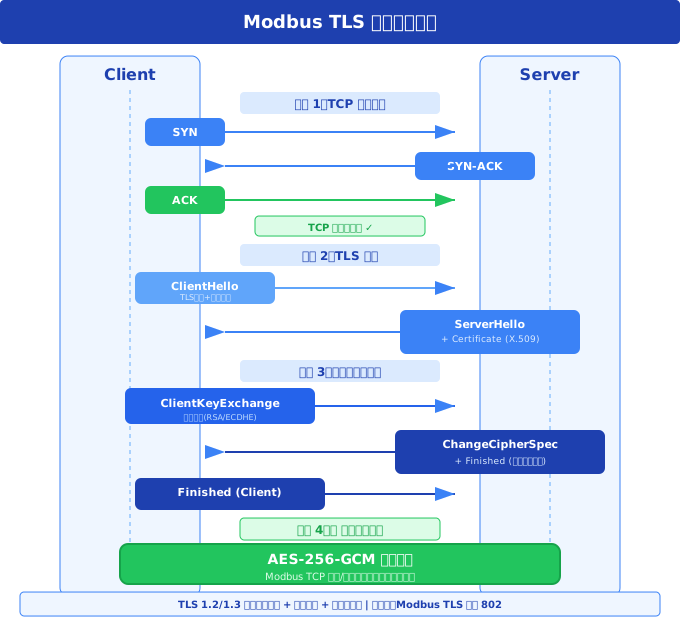
2.2 Security handshake process
The connection establishment of the Modbus security protocol is divided into two phases:
- TLS handshake:The client and server engage in a standard TLS handshake to negotiate encryption suites, exchange certificates, and establish an encrypted channel
- Certificate verification:Both parties verify the validity of each other's certificates (signature chain, expiration date, revocation status)
- Role negotiation:Determine device role (client/server) through the Extended Key Usage (EKU) extension field in the X.509v3 certificate
- Modbus communication:Standard Modbus PDU exchange within the TLS encrypted channel
Modbus 安全协议握手流程(简化):

Client                                          Server
  │                                               │
  │──── TCP SYN (端口 802) ──────────────────────→│
  │←─── TCP SYN-ACK ──────────────────────────────│
  │──── TCP ACK ─────────────────────────────────→│
  │                                               │
  │──── ClientHello (支持的加密套件) ──────────────→│
  │←─── ServerHello + 服务器证书 ──────────────────│
  │←─── CertificateRequest (请求客户端证书) ───────│
  │──── ClientCertificate + ClientKeyExchange ────→│
  │──── CertificateVerify ────────────────────────→│
  │──── ChangeCipherSpec + Finished ──────────────→│
  │←─── ChangeCipherSpec + Finished ──────────────│
  │                                               │
  │◄═════ TLS 加密通道已建立 ═════════════════════►│
  │                                               │
  │──── Modbus PDU (加密) ────────────────────────→│
  │←─── Modbus PDU (加密) ────────────────────────│
  │                                               │
III. Application of X.509v3 Certificate in Modbus Security Protocol
3.1 Role Definition in the Certificate
The Modbus security protocol defines the device role through the Extended Key Usage (EKU) extension of the X.509v3 certificate:
| Role | EKU OID | Description |
|---|---|---|
| Modbus Client | 1.3.6.1.4.1.50316.802.1 | The party initiating the request (master station) |
| Modbus Server | 1.3.6.1.4.1.50316.802.2 | The party responding to the request (slave station) |
After the TLS handshake is completed, both parties check the EKU extensions in each other's certificates to ensure role matching. For example, if the server certificate contains a client EKU, or the client certificate contains a server EKU, the connection will be rejected.
3.2 Certificate Lifecycle Management
In an industrial automation environment, certificate management faces unique challenges:
- Long Device Lifespan:Industrial devices may operate for 10 to 20 years, and certificates must be planned with validity periods in advance
- Offline Environment:Many industrial networks cannot access the internet and cannot use certificates issued by public CAs
- Massive Number of Devices:A factory may have thousands of Modbus nodes, making it impractical to manage certificates one by one
Recommended Solution:Establish a local PKI (Public Key Infrastructure) and use a private CA to issue certificates:
# 使用 OpenSSL 搭建工业级私有 CA

# 步骤 1: 创建根 CA 密钥和证书
openssl genrsa -out rootCA.key 4096
openssl req -x509 -new -nodes -key rootCA.key
  -sha256 -days 7300 -out rootCA.crt
  -subj "/C=CN/ST=Guangdong/L=Shenzhen/O=FactoryName/CN=Factory Root CA"

# 步骤 2: 创建 Modbus 服务器证书
openssl genrsa -out server.key 2048
openssl req -new -key server.key -out server.csr
  -subj "/C=CN/ST=Guangdong/L=Shenzhen/O=FactoryName/CN=PLC-001"

# 步骤 3: 添加 EKU 扩展(Modbus 服务器角色)
cat > server_eku.cnf <<EOF
[ext]
extendedKeyUsage = 1.3.6.1.4.1.50316.802.2
keyUsage = digitalSignature, keyEncipherment
EOF

# 步骤 4: 使用 CA 签发证书
openssl x509 -req -in server.csr -CA rootCA.crt -CAkey rootCA.key
  -CAcreateserial -out server.crt -days 3650 -sha256
  -extfile server_eku.cnf -extensions ext
IV. Encryption Suite Selection
Not all TLS cipher suites are suitable for industrial environments. A balance between security and performance is required:
4.1 Recommended cipher suites
| Cipher suite | Security level | Performance impact | Recommendation |
|---|---|---|---|
| TLS_ECDHE_ECDSA_WITH_AES_128_GCM_SHA256 | High | Low | ★★★★★ |
| TLS_ECDHE_RSA_WITH_AES_128_GCM_SHA256 | High | In the middle | ★★★★☆ |
| TLS_ECDHE_ECDSA_WITH_AES_256_GCM_SHA384 | Extremely high | In the middle | ★★★★☆ |
| TLS_AES_128_GCM_SHA256 (TLS 1.3) | High | low | ★★★★★ |
Recommendation:AES-128-GCM has hardware acceleration support on most embedded chips of the ARM Cortex-M class, with minimal performance loss. For embedded devices with limited resources, AES-128-GCM is the best choice.
4.2 TLS Performance on Embedded Devices
The computational overhead of the TLS handshake is mainly concentrated in asymmetric encryption operations (certificate signature verification, key exchange). The following is test data for TLS 1.2 handshake time on different platforms:
| Platform | CPU | Frequency | TLS Handshake Time |
|---|---|---|---|
| Raspberry Pi 4 | Cortex-A72 | 1.5 GHz | ~15 ms |
| STM32H7 | Cortex-M7 | 480 MHz | ~350 ms |
| ESP32 | Xtensa LX6 | 240 MHz | ~800 ms |
| STM32F4 (with software ECC) | Cortex-M4 | 168 MHz | ~3~5 seconds |
Important:On devices with extremely limited resources (such as the STM32F4 series), it is recommended to use ECDSA certificates (rather than RSA) because the signature verification speed of ECDSA is much faster than that of RSA. Alternatively, consider using Pre-Shared Key (PSK) mode to avoid asymmetric encryption operations.
V. Interoperability with Standard Modbus TCP
The Modbus security protocol is designed to be backward compatible. The same device can support both standard Modbus TCP (port 502) and Modbus security protocol (port 802) simultaneously, but this poses a critical security issue:
If a device opens both ports 502 and 802, an attacker can bypass all security mechanisms using port 502!
Security Deployment Recommendations:
- In production environments, close port 502 and only open port 802.
- If port 502 must be retained (such as for compatibility with legacy systems), use a firewall to restrict access to port 502 to specific IPs/subnets.
- Implement read-only restrictions at the application layer on port 502 (if supported by the device).
VI. Programming Implementation of Modbus Security Protocol
Below is a complete example of implementing a Modbus security protocol client using Python:
#!/usr/bin/env python3
"""
Modbus 安全协议客户端示例
使用 TLS 加密连接到 Modbus Security 服务器(端口 802)
"""

import ssl
import socket
import struct

class ModbusSecurityClient:
    def __init__(self, host, port=802):
        self.host = host
        self.port = port

        # 创建 TLS 上下文
        self.ssl_context = ssl.create_default_context(
            purpose=ssl.Purpose.SERVER_AUTH
        )

        # 加载客户端证书和密钥
        self.ssl_context.load_cert_chain(
            certfile='client.crt',
            keyfile='client.key'
        )

        # 加载 CA 证书(用于验证服务器证书)
        self.ssl_context.load_verify_locations(
            cafile='rootCA.crt'
        )

        # 强制要求验证服务器证书
        self.ssl_context.verify_mode = ssl.CERT_REQUIRED

        # 设置最低 TLS 版本
        self.ssl_context.minimum_version = ssl.TLSVersion.TLSv1_2

        self.sock = None
        self.transaction_id = 0

    def connect(self):
        """建立 TLS 安全连接"""
        raw_sock = socket.socket(socket.AF_INET, socket.SOCK_STREAM)
        raw_sock.settimeout(5.0)

        # 将普通 socket 包装为 TLS socket
        self.sock = self.ssl_context.wrap_socket(
            raw_sock,
            server_hostname=self.host
        )
        self.sock.connect((self.host, self.port))

        # 获取并验证服务器证书
        server_cert = self.sock.getpeercert()
        print(f"已连接到 {server_cert['subject']}")
        print(f"TLS 版本: {self.sock.version()}")
        print(f"加密套件: {self.sock.cipher()}")

    def read_holding_registers(self, unit_id, start_addr, count):
        """功能码 0x03 - 读保持寄存器"""
        self.transaction_id += 1

        # 构造 MBAP 报头 + PDU
        mbap = struct.pack('>HHHB',
            self.transaction_id,  # 事务标识符
            0x0000,               # 协议标识符
            0x0006,               # 长度(unit_id + func + data)
            unit_id               # 单元标识符
        )

        pdu = struct.pack('>BHH',
            0x03,        # 功能码:读保持寄存器
            start_addr,  # 起始地址
            count        # 寄存器数量
        )

        request = mbap + pdu

        # 通过 TLS 加密通道发送
        self.sock.sendall(request)

        # 接收响应
        response = self.sock.recv(1024)

        # 解析 MBAP 报头
        tid, pid, length, uid = struct.unpack('>HHHB', response[:7])

        if tid != self.transaction_id:
            raise Exception("事务 ID 不匹配!")

        # 解析 PDU
        func = response[7]
        if func & 0x80:
            raise Exception(f"异常码: 0x{response[8]:02X}")

        byte_count = response[8]
        data = response[9:9+byte_count]

        return data

    def close(self):
        if self.sock:
            self.sock.close()


# 使用示例
if __name__ == '__main__':
    client = ModbusSecurityClient('192.168.1.100', 802)
    try:
        client.connect()
        data = client.read_holding_registers(1, 0x0000, 10)
        print(f"读取到数据: {data.hex()}")
    finally:
        client.close()
VII. Best Practices for Security Deployment Checklist
| # | Check Items | Priority |
|---|---|---|
| 1 | Use Modbus security protocol (port 802) instead of standard Modbus TCP (port 502) | 🔴 High |
| 2 | Deploy a private PKI and use ECDSA certificates (preferably over RSA) | 🔴 High |
| 3 | Use TLS version 1.2 and above, disable TLS 1.0/1.1 | 🔴 High |
| 4 | Correctly set the EKU extension in the certificate to distinguish between client/server roles | 🟡 Medium |
| 5 | If both 502 and 802 are open, use a firewall to restrict the access scope of 502 | 🔴 High |
| 6 | Establish a certificate lifecycle management system (regular rotation, revocation list) | 🟡 Medium |
| 7 | Implement application-level access control for critical registers (read-only/read-write separation) | 🟡 Medium |
| 8 | Deploy a Network Intrusion Detection System (NIDS) to monitor abnormal Modbus communication behavior | 🟢 Low |
| 9 | Record and audit all Modbus write operations (who, when, what was written) | 🟡 Medium |
VIII. Frequently Asked Questions (FAQ)
Q1: Does the Modbus security protocol significantly increase communication latency?
The TLS handshake phase involves a one-time delay (ranging from hundreds of milliseconds to several seconds, depending on device performance), but once the handshake is completed, the delay for symmetric encryption (AES-GCM) is only in the microsecond range. For most Modbus communication scenarios (polling frequency ranging from 100ms to 1s), the impact of TLS encryption delay is negligible. It is recommended to use persistent connections (Keep-Alive) to avoid frequent handshakes.
Q2: Can existing Modbus TCP devices be upgraded to the Modbus security protocol?
If the device implements Modbus TCP purely in hardware (with no firmware updates possible), it cannot be upgraded. However, if the device runs an embedded operating system and has sufficient resources, TLS support can be added through firmware updates. Alternatively, a proxy gateway supporting the Modbus security protocol can be deployed at the front end of the device.
Q3: Is it safe to use private self-signed certificates in industrial environments?
In an enterprise intranet environment, using certificates issued by a private Certificate Authority (CA) (rather than self-signed certificates) is completely safe, provided that the CA private key is securely stored, the certificate domain name/IP is correctly bound, and the revocation mechanism is functioning properly. Self-signed certificates (not issued by a CA) should be avoided as they cannot achieve effective trust chain verification.
IX. Future Outlook
With the mandatory implementation of IEC 62443 (Industrial Automation and Control Systems Security Standard) globally, the Modbus security protocol will gradually transition from being an "optional" to a "mandatory" requirement. More and more industrial equipment suppliers are beginning to incorporate Modbus security protocol support in their flagship products. For new projects, adopting the Modbus security protocol from the outset is the most forward-thinking architectural decision.
Related Reading:Best Practices for Modbus TCP/IP Network Deployment | In-depth Comparison between Modbus RTU and TCP | Advanced Applications of Modbus in Industrial IoT


Leave a Reply