Preface
Those who have used node-red are well aware of its many advantages. With minimal coding, it can fulfill business needs, and its rich set of nodes allows it to cater to most business scenarios. It also enables the re-deployment of new flows without restarting the application... These features make developers reluctant to part with it. However, when it comes to its shortcomings, there are indeed some. It does not support multi-tenancy, does not isolate multi-user data, and does not persist data to a database. As node-red evolves, the official team has realized that its shortcomings become particularly prominent when facing more complex business scenarios, which has limited its entry into larger markets, such as the Pass platform. Therefore, the official team began to consider developing a devops platform for node-red that can manage multiple instances of node-red. This platform is FlowForge. @CSDN Get me a shirt
Introduction to FlowForge
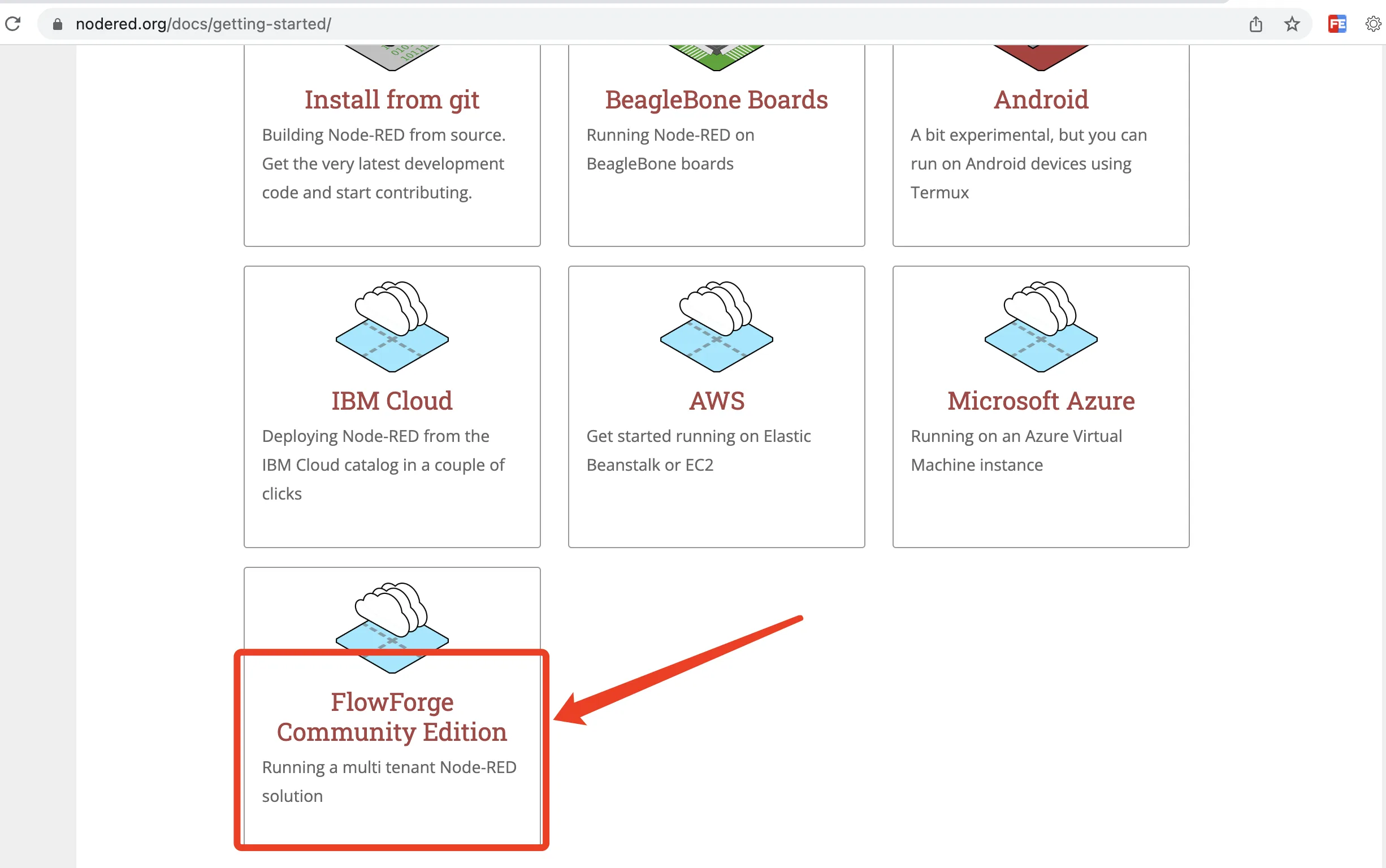
There is a link to FlowForge on the node-red documentation page. https://nodered.org/docs/getting-started/ It is at the bottom.
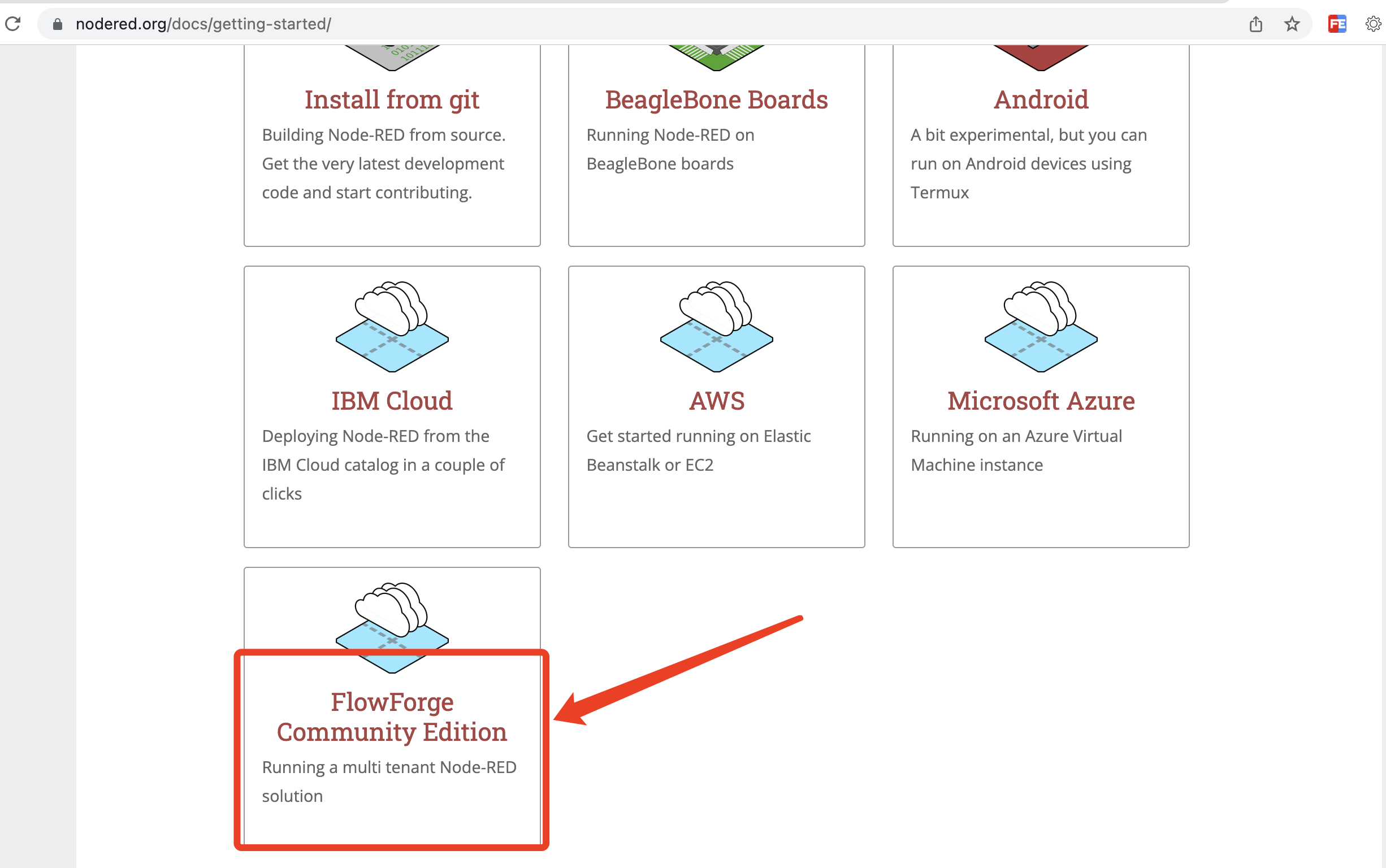
Here, it is officially described by node-red as a solution for running multiple tenants of node-red.
FlowForge provides a platform for collaboration on Node RED projects, which can be installed on public clouds, personal servers, or local machines.
@CSDN Get me a shirt
There are multiple ways to run FlowForge; locally, based on Docker, or Kubernetes. When evaluating whether FlowForge is suitable for you, it is recommended to start with a local installation.
The official address of FlowForge is https://flowforge.com/
It is described as a devops platform for node-red, allowing organizations to reliably deliver Node RED applications in a continuous, collaborative, and secure manner.
Why use FlowForge?
Collaborative development
FlowForge adds team collaboration to Node RED, allowing multiple developers to work together on a single instance. With FlowForge, developers can easily share projects, collaborate in real-time, and simplify workflows to accelerate development and deployment.
Managing Remote Deployments
Many organizations deploy Node RED instances to remote servers or edge devices. FlowForge automates this process by creating snapshots of Node RED instances that can be deployed to multiple remote targets. It also allows for rollbacks in case something goes wrong.
Simplifying Application Delivery
FlowForge simplifies the software development lifecycle of Node RED applications. You can set up a DevOps delivery pipeline to support the development, testing, and production environments for Node RED application delivery.
Flexible FlowForge Deployment
You can easily use FlowForge, which offers a set of solutions including FlowForge Cloud, hosted cloud services, or self-hosted solutions. With this solution, server operations are handed over to the official team. You are free to choose the deployment method that best suits your organization.
Professional Support for Node RED Deployments
FlowForge is a trusted partner providing professional support for Node RED-based business-critical applications. Official experts can assist developers with any challenges, ensuring smooth and secure operation of Node RED applications. The latest version of Node RED and security updates are provided to ensure operational continuity.
The above five reasons are provided by the official team. Personally, I believe the first three reasons are sufficient for most to choose FlowForge.
Summary
This article aims to give you a general understanding of FlowForge. Overall, this platform was open-sourced in July 2021, and although it's not yet fully mature, its core functionalities are already in place. Therefore, I will write a series of articles to explain various aspects of FlowForge. Stay tuned.


Leave a Reply