
Application and Advantages of Serial Device Servers in MODBUS Communication
With the gradual maturity of industrial automation and IoT technology, communication protocols and technologies are evolving rapidly. MODBUS, as a classic and widely used industrial communication protocol, continues to be popular in the industrial field. In MODBUS communication, the emergence of serial device servers has greatly enhanced the application scope and efficiency of this protocol. This article will explore the application of serial device servers in MODBUS communication and the advantages they bring.
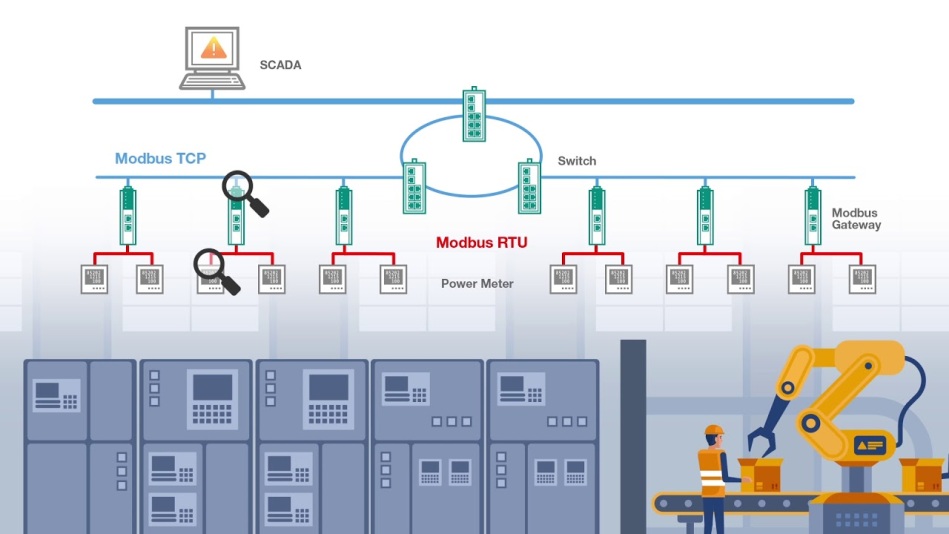
1. Introduction to Serial Device Servers
Serial device servers, also known as terminal servers or serial port redirectors, are devices that can convert serial data into Ethernet data. They enable serial communication devices to communicate directly with other devices over Ethernet, greatly increasing communication distance and efficiency.
2. Application of Serial Device Servers in MODBUS Communication
- Extending Communication Distance: The traditional MODBUS RTU protocol uses RS-232 or RS-485 as the physical layer, which significantly limits its communication distance. However, through serial device servers, MODBUS RTU devices can easily communicate over long distances via IP networks.
- Protocol Conversion: Serial device servers not only support the conversion from MODBUS RTU to MODBUS TCP but also allow for the conversion between multiple protocols, facilitating communication between different devices.
- Centralized Management and Monitoring: Serial device servers can connect multiple MODBUS RTU devices to a centralized management platform, enabling administrators to monitor and control all devices from a single interface.
3. Advantages of Serial Device Servers
- Enhancing System Reliability: Serial devices servers typically possess robust protection capabilities, such as lightning protection and surge protection, ensuring stable and reliable communication.
- Reducing Overall Costs: By utilizing serial device servers, enterprises can reduce network cabling and eliminate the need for repeaters or amplifiers due to communication distance.
- Simplifying Network Structure: Serial device servers can provide a unified IP address for multiple serial devices, simplifying network configuration and management.
- Offering Enhanced Functionalities: Many advanced serial device servers also provide features such as VPN, firewall, and traffic control, further enhancing the security and stability of the system.
- Flexible Scalability: As the number of industrial field devices increases, the system can be easily scaled by adding serial device servers without requiring large-scale modifications to the existing network structure.
Conclusion
The application of serial device servers in MODBUS communication has significantly propelled the development of industrial automation. It not only overcomes the limitations of traditional serial communication but also brings more possibilities to modern industrial communication. Considering its evident advantages, serial device servers are a crucial component worth considering, whether for upgrading existing systems or deploying new ones.


Leave a Reply