
Industrial Internet of Things (IIoT) involves the integration of various acquisition and control sensors or controllers with sensing and monitoring capabilities, as well as technologies such as mobile communication and intelligent analysis, into various aspects of industrial production processes. This significantly enhances manufacturing efficiency, improves product quality, reduces product costs and resource consumption, and ultimately brings traditional industries to a new stage of intelligence. In terms of application forms, IIoT applications are characterized by real-time performance, automation, embedded software, security, and interconnected information.
The importance of IIoT lies in its ability to assist enterprises in making faster and better decisions, and the changes it brings are closely related to many enterprises' ongoing digital transformation projects.
IIoT should not be confused with Consumer Internet of Things (CIoT), but the core concept of CIoT is essentially the same as that of IIoT: using sensors and automation to improve efficiency.
According to relevant data, by 2025, the number of connections to the global industrial IoT will reach 13.8 billion, with Greater China accounting for 4.1 billion connections, approximately one-third of the global market. Meanwhile, according to data from the Ministry of Industry and Information Technology, the annual revenue growth rate of China's industrial IoT market is about 25%, exceeding RMB 300 billion in 2018. This indicates that IoT and IIoT are entering a period of rapid development.
The research on IIoT technology is an interdisciplinary project involving automation, communication, computer science, and management science.
The widespread application of IIoT requires the resolution of numerous key technical issues.
Technologies required for IIoT:
Sensor technology
Low-cost, high-performance sensors are the cornerstone of IIoT applications. The development of IIoT demands sensor technologies that are more accurate, intelligent, efficient, and compatible. Intelligent data acquisition technology is a new direction for the development of sensor technology. The ubiquitous nature of information poses higher requirements for industrial sensors and sensing devices. Specifically, miniaturization: the miniaturization of components requires resource and energy conservation; intelligence: artificial intelligence technologies such as self-calibration, self-diagnosis, self-learning, self-decision-making, self-adaptation, and self-organization; low-power and energy harvesting technologies: power supply methods include batteries, sunlight, wind, temperature, vibration, and other methods.
Device compatibility technology
In most cases, enterprises build Industrial Internet of Things (IIoT) based on existing industrial systems. One of the challenges in promoting IIoT is how to ensure compatibility between the sensors used in IIoT and the sensors already applied in existing equipment. Sensor compatibility mainly refers to compatibility in data format and communication protocol, and the key to compatibility lies in the unification of standards. Currently, widely adopted protocols such as Profibus and Modbus in industrial fieldbus networks have effectively addressed the issue of compatibility. Most industrial equipment manufacturers have developed various sensors, controllers, and other components based on these protocols. In recent years, with the increasing popularity of industrial wireless sensor network applications, the current major standards for industrial wireless, including WirelessHART, ISA100.11a, and wIA-PA3, all support the IEEE802.15.4 wireless network protocol and provide a tunneling mechanism to ensure compatibility with existing communication protocols, enriching the composition and functionality of IIoT systems.
network technology
The network is one of the core components of the Industrial Internet of Things (IIoT), facilitating data transmission between different levels of the system. Networks are categorized into wired and wireless types. Wired networks are typically employed in cluster servers of data processing centers, local area networks within factories, and certain fieldbus control networks, providing high-speed and high-bandwidth data transmission channels. Industrial wireless sensor networks, on the other hand, represent an emerging technology that utilizes wireless technology for sensor networking and data transmission. The application of wireless network technology significantly reduces the wiring costs of industrial sensors, facilitates the expansion of sensor functionalities, and thus attracts the attention of numerous enterprises and research institutions both domestically and internationally. Traditional wired network technology is relatively mature and has been validated in various applications. However, when wireless network technology is applied in industrial environments, it faces several challenges: strong electromagnetic interference in industrial sites, open wireless environments that make industrial machines more vulnerable to attack threats, and the need for real-time transmission of certain control data. Compared to wired networks, industrial wireless sensor network technology is still in its developmental stage. It addresses the deficiencies of traditional wireless network technology when applied in industrial field environments, offering high reliability, real-time performance, and security. The main technologies include adaptive frequency hopping, deterministic communication resource scheduling, wireless routing, low-cost high-precision time synchronization, network layered data encryption, network anomaly monitoring and alarming, and device network access authentication.
Information Processing Technology
The explosion of industrial information and the vast amount of data generated during industrial production processes pose challenges to the IIoT. How to effectively process, analyze, and record this data, extracting results that provide guidance for industrial production, is the core and difficulty of the IIoT. Currently, there are many big data processing technologies in the industry, such as SAP's BW system, which to some extent addresses the issues brought by big data to enterprise production and operations. The development of data fusion and data mining technologies has also made massive information processing more intelligent and efficient. The ubiquitous sensing characteristics of the IIoT make humans the objects of perception as well. Through the analysis of environmental data and the modeling of user behaviors, it is possible to perceive behaviors, environments, and states among humans, humans and machines, and machines and machines in the production design, manufacturing, and management processes, more accurately reflecting the detailed changes in industrial production processes to obtain more accurate analysis results.
Security Technology
Industrial IoT security mainly involves processes such as data acquisition security and network transmission security. Information security plays a crucial role in enterprise operations. For example, in industries such as metallurgy, coal, and petroleum, data acquisition requires long-term continuous operation. How to ensure the accuracy and correctness of information during data acquisition and transmission is a prerequisite for the application of the IIoT in actual production. [2]
Application areas
Manufacturing supply chain management
By utilizing IoT technology, enterprises can grasp timely information regarding raw material procurement, inventory, sales, and more. Through big data analysis, they can also predict the price trend and supply-demand relationship of raw materials, which aids in refining and optimizing the supply chain management system, enhancing supply chain efficiency, and reducing costs. Airbus has established the largest and most efficient supply chain system in global manufacturing by applying sensor network technology within its supply chain system.
Process optimization in production process
The ubiquitous sensing characteristics of the Industrial Internet of Things (IIoT) have enhanced the capabilities and standards of production line process monitoring, real-time parameter collection, and material consumption tracking. Through data analysis and processing, intelligent monitoring, control, diagnosis, decision-making, and maintenance can be achieved, thereby boosting productivity and reducing energy consumption. Steel enterprises have employed various sensors and communication networks to achieve real-time monitoring of the width, thickness, and temperature of processed products during production, enhancing product quality and optimizing production processes.
Production equipment monitoring and management
Utilizing sensing technology to monitor the health of production equipment allows for timely tracking of the usage status of various industrial machinery and devices during the production process. By aggregating data through the network to the data analysis center of equipment manufacturers for processing, it is possible to effectively diagnose and predict machine failures, quickly and accurately locate the cause of faults, improve maintenance efficiency, and reduce maintenance costs. GE Oil & Gas has established 13 i-Centers (integrated service centers) globally, targeting different products. Through sensors and networks, they conduct online and real-time monitoring of equipment, and provide solutions for equipment maintenance and fault diagnosis.
Environmental monitoring and energy management
The integration of industrial IoT and environmental protection equipment enables real-time monitoring of various pollution sources generated during industrial production processes and key indicators of pollution control links. Deploying sensor networks in enterprises such as chemical, light industry, and thermal power plants not only allows for real-time monitoring of corporate pollution discharge data but also enables the timely detection of abnormal pollution discharge through intelligent data alarms, leading to the cessation of corresponding production processes and preventing sudden environmental pollution accidents. Telecommunications operators have begun promoting real-time monitoring solutions for pollution control based on IoT.
Industrial safety production management
"Safe production" is of utmost importance in modern industry. Industrial IoT technology, by installing sensors in hazardous work environments such as mining equipment, oil and gas pipelines, and mining equipment, can monitor the safety status information of operators, equipment machines, and the surrounding environment in real time, comprehensively acquiring safety factors in the production environment. It elevates the existing network supervision platform to a systematic, open, and diversified comprehensive network supervision platform, effectively ensuring industrial production safety.
Application of Industrial Internet of Things (IIoT)
If we abstract the application of IoT in the industrial sector, we can summarize it into four levels:
Data collection and display, basic data analysis and management, deep data analysis and application, and industrial control.
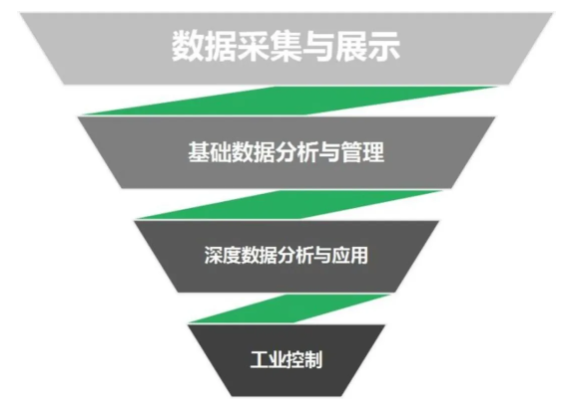
▶ Data collection and display: It mainly involves transmitting data information collected by industrial equipment sensors to the cloud platform and presenting the data in a visual manner.
▶ Basic data analysis and management: This stage tends to be focused on general analysis tools, without involving in-depth industry-specific knowledge-based data analysis. Based on the equipment data collected by the cloud platform, some SaaS applications are generated, such as alerts for abnormal equipment performance indicators, fault code queries, and correlation analysis of fault causes.
▶In-depth data analysis and application: In-depth data analysis involves industry knowledge specific to particular fields and requires industry experts in those fields to implement it. Specifically, data analysis models are established based on the field and characteristics of the equipment.
▶ Industrial Control: The purpose of the Industrial Internet of Things (IIoT) is to enable precise control over industrial processes. Based on the aforementioned processes of sensor data collection, display, modeling, analysis, and application, decisions are made in the cloud and converted into control instructions that industrial equipment can understand. These instructions are then executed on the industrial equipment, enabling precise information exchange and efficient collaboration among industrial equipment resources.
The industrial sector encompasses numerous vertical industries, each with vastly different characteristics. The integration of the Internet of Things (IoT) with each industry also requires adjustments based on the industry's unique characteristics. Although currently primarily adopted by large enterprises, its wider adoption may be possible as hardware and service prices decline.
5G is the best partner for Industrial Internet of Things (IIoT)
IIoT is still mainly in the experimental and pilot phase, with only a few large manufacturers making significant investments. As sensors become smaller and cheaper, especially with the widespread adoption of 5G networks, the characteristics of 5G, such as high bandwidth, low latency, and wide coverage, make it possible to realize industrial internet scenarios that were unachievable with traditional 4G networks in the 5G era. Interest in IIoT may continue to grow.
For example, in port terminals, steel cranes transfer and load large cargo between the dock and ships, requiring minimal latency and accuracy errors, while being able to detect abnormalities and respond quickly at the edge. This was only imaginable in the past. Another example is high-temperature and high-risk steel plants that urgently need to achieve unmanned operation and can accurately pour molten steel at thousands of degrees in an instant, requiring latency as low as milliseconds. This was also unimaginable in the 4G era.
You may wonder: Since the above scenarios have such stringent requirements for network latency and stability, why not adopt stable and high-speed wired methods? In fact, wired methods may seem simple and easy to implement, but they are actually fraught with problems. Wired network deployment is relatively complex, and subsequent upgrades and modifications also involve a lot of work; moreover, the use of wired networks is limited by conditions, while the industrial IoT environment is complex and diverse, making it impossible to deploy wired networks everywhere where needed. Relatively speaking, wireless networks represented by 5G are a more economical and efficient connection method.
The equipment investment in the industrial sector is huge, whether it is machine tools, production lines, or mechanical equipment. Downtime caused by failures in the production process often affects the entire production line, even the entire product delivery cycle.
To ensure stability, the control system in the industrial sector is still primarily local, deploying a large number of hardware and software systems. On the one hand, this makes the entire control system very complex and requires significant investment. On the other hand, it also limits the flexibility and scalability of the system. In today's rapidly changing consumer demands, the updating of production systems cannot keep up with changes in consumer demands, which can also lead to missed opportunities.
Furthermore, the current mobile communication systems are not deeply applied in the field of industrial IoT. Although 4G has significantly improved in terms of network speed, enabling users to watch videos anytime, there is still considerable room for improvement in terms of network reliability and latency, which cannot meet the requirements of industrial scenarios.
The application of 4G in industrial scenarios is primarily used as a method for uploading data to the cloud in scenarios where real-time performance is not critical. For instance, machine tools in factories collect data every 5-10 seconds, and these data are typically aggregated to a unified terminal, which then sends them to the cloud platform via 4G.
The technical standards of 5G can well meet these demands of the industrial field for communication systems. The extremely low latency ensures the real-time monitoring and control requirements of the industrial field; the highly reliable network quality guarantees the stability requirements of industrial systems; and the large bandwidth enables the transmission of high-definition 3D videos and even AR, significantly improving the operation accuracy in the field of remote control.
For the industrial sector, a highly reliable and low-latency communication system is crucial. Historically, the application of industrial IoT has only been limited to superficial data collection and display, as well as some management functions derived from it, rarely involving core areas such as industrial system control. The main constraints are the instability and latency of the communication system, which fail to meet the required standards.
In the view of research institutions, the potential of IIoT is boundless. According to a report released by GSMA Intelligence, the market opportunities for 5G and IoT in the telecommunications industry in the future are more dependent on enterprises rather than individual users. From the perspective of IoT, although consumer electronics and smart home scenarios are currently the main force of IoT, the potential of the enterprise market in the future is boundless. From manufacturing to the power industry, 5G and IoT will create new opportunities to meet a wide range of enterprise needs.


Leave a Reply