
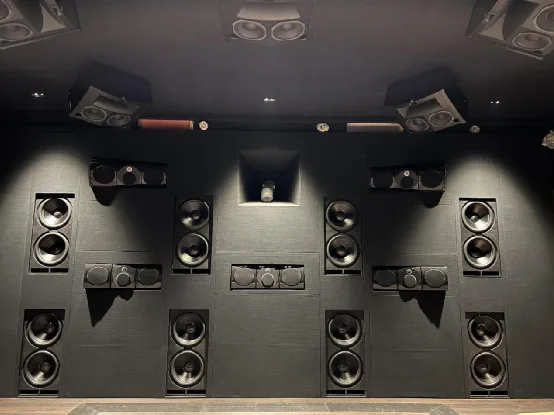
Although Dolby Atmos has been released for ten years, it remains unclear to newcomers in home theater, especially when it comes to setting up the overhead speakers. What's more, the recommendations for channel positions vary among AV amplifier manufacturers, and considering the compatibility with other 3D sound technologies (such as DTS:X and Auro-3D) adds to the confusion, even for experienced users.
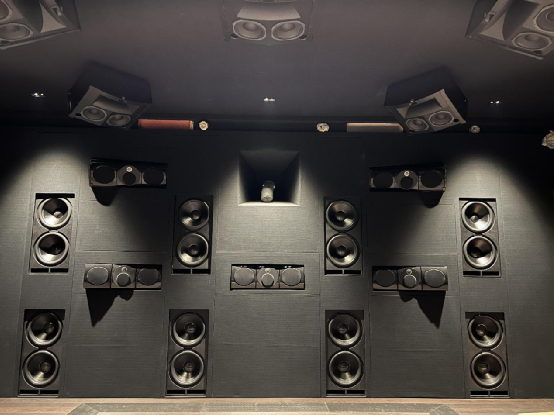
Today, based on the "Dolby Atmos Home Theater Installation Guidelines" (also known as the Dolby Atmos white paper), we will explain to beginners how to determine the installation positions for the overhead speakers in a Dolby Atmos home theater.
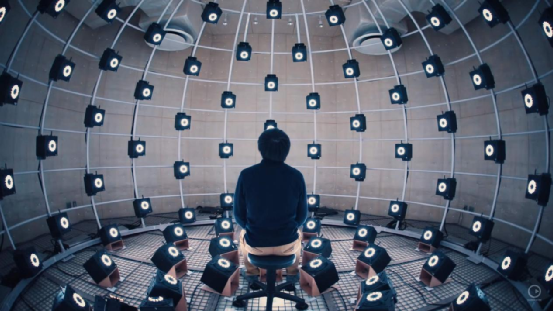
Dolby Atmos, released by Dolby Laboratories on April 24, 2012, is a 3D surround sound technology that breaks through the traditional concepts of 5.1 and 7.1 channels. It can combine film content to present dynamic 3D sound effects.
Previous home theaters simply reproduced sound effects rigidly, while Dolby Atmos is a brand-new mixing and sound directional method that is based on your environment and audio equipment combination, through dynamic calculation and reproduction of sound objects by an AV amplifier, allowing the audience to be surrounded by sound in all directions.
The biggest difference in hardware is the addition of the "overhead channels," or top-mounted speakers. The larger the room, the more channels should be provided. Currently, civilian AV preamps can support up to 32 channels, such as the Trinnov Audio Altitude32.
There are several types of 3D sound effects, but why do we specifically mention Dolby Atmos? Because Dolby is currently the mainstream, while others have become marginalized and have limited film sources.
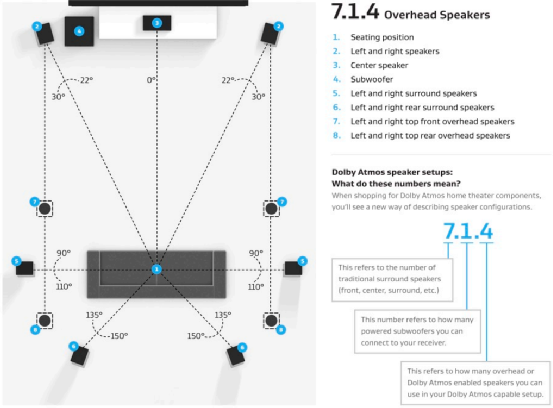
Regarding the positioning of top-mounted speakers, some people place too much emphasis on the specific location, wanting to be precise to the millimeter; others place them randomly without much care, which is also not advisable.
Looking closely at the image above, you can see that each channel is labeled with an angle. In fact, the angle ranges given by Dolby are relatively wide, and basically, as long as they are within the range, it's not a big issue. If the deviation is too large, it will seriously disrupt the sound image positioning, and no sound technology can save it.
Since the dimensions and proportions of each home theater room vary, the following discussion on speaker placement is based on angles, rather than dimensions and distances.
As for the actual distance, it can be calculated using trigonometric functions in junior high school. There is also a simpler method: use CAD to draw the diagram, find the right angle and size, and the distance will be directly displayed.
The perspective often discussed here is often misunderstood as referring to the angle at which the speakers are facing. It's not. Instead, it refers to the angle formed by the line connecting the listening position and the center channel, with each channel intersecting at the listening position. By treating each speaker (channel) as a mass point, the calculation of the angle becomes straightforward.
Let's clarify the issue of speaker orientation here, especially regarding the ground-based sound channels.
It is recommended that surround speakers not be aimed directly at the ears to avoid disrupting the surround sound experience. Except for special purposes (such as off-axis response, coverage range, and reflected sound control), all speakers should be placed perpendicular to the wall and not face the audience. As for overhead speakers, if the floor and ceiling have not undergone deep acoustic treatment, it is recommended to aim them at the listening position.
Taking four overhead speakers as an example, let's look at how to determine the placement points from the perspectives of length and width.
At first glance, the channel layout in the Dolby Atmos white paper gives the illusion that the overhead channels should be aligned with the left and right front channels...
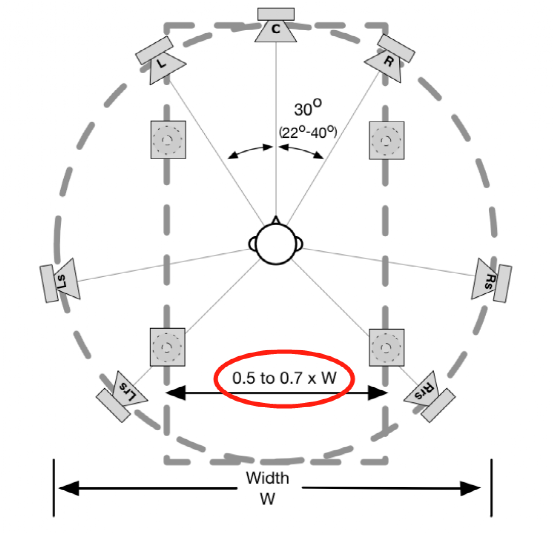
In fact, this is not the case. Dolby recommends that in a home environment, the horizontal distance between two overhead speakers should be 0.5-0.7 times the total width of the room. For example, if your room is 4 meters wide, the distance between the two speakers should be between 2-2.8 meters.
The actual horizontal distance also depends on specific circumstances. If your room is tall, use 0.7, and if it is relatively short, try to use 0.5.
After positioning the speakers in the width direction, let's look at how to determine the position in the length direction.
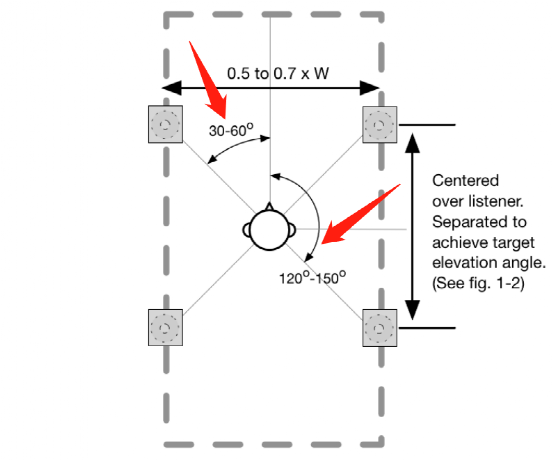
The image below is still a top-down view. The angle between the two horizontal speakers and the center speaker should be 30-60 degrees (it is recommended to use the intermediate value of 45 degrees), which also determines the speaker placement points in the length direction.
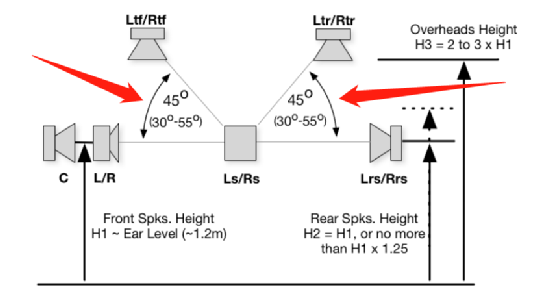
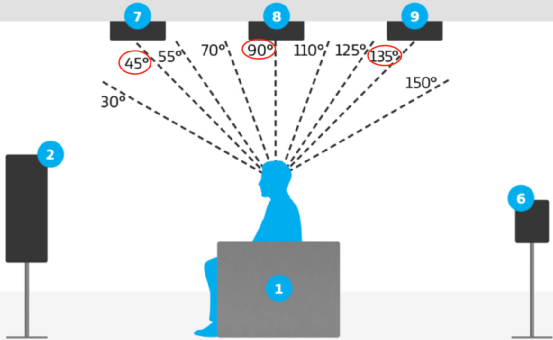
Additionally, because room heights vary, and some rooms may be particularly tall, Dolby also provides a limited range in the vertical angle. It is recommended that the angle between the four overhead speakers and the front and surround speakers be between 30-55 degrees, further clarifying the position.
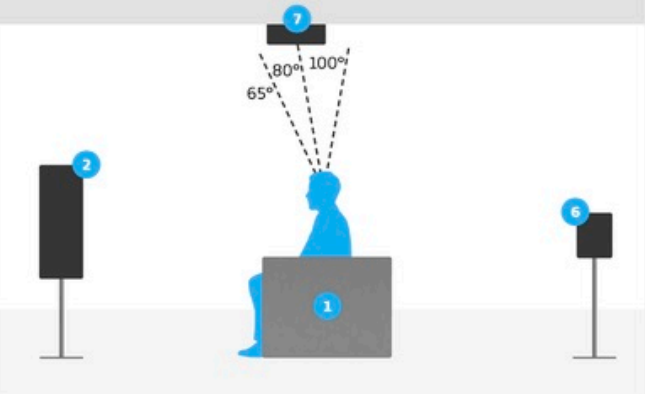
If there are only two overhead speakers, the recommended range is between 65-100 degrees, and they can be placed directly above the listening position.
What if there are six overhead speakers? The principle is the same, and you can see the angle in the image below.


Leave a Reply